

The first year I processed a deer at home, I did the whole thing with one knife. A cheap drop-point from a five-knife combo pack that came free with a rifle scope purchase, if I remember right. Hours later I had sore hands, a dull blade, and a cooler of venison that had more ragged cuts than clean steaks. I didn’t know yet that quartering, boning, and trimming are three different jobs that want three different blades.
That’s the problem with how butcher knife sets get marketed. A lot of them are built for a photo on a cardboard sleeve, not for the actual sequence of tasks you go through breaking down a whitetail on a garage table. You end up with a caping knife doing a boning knife’s job, or a “butcher knife set” that’s really just three skinning knives in slightly different lengths. The set looks complete until you’re elbow-deep in a hindquarter and realize nothing in the box is stiff enough to separate a big muscle group cleanly.
I’ve run all five sets in this guide on deer taken here in southeast Minnesota, in a cold garage in November and a heated one in late December, which matters more than people think, more on that in the buying guide. I’ve also broken down enough deer with just one all-purpose knife to know exactly what a real set should fix. This isn’t a rebrand of a field-dressing kit list. Every pick here is built around the actual home-processing job: hide off, quarters down, meat boned and trimmed for the freezer.
What follows is five sets that cover different budgets and different processing styles, a straight comparison table, and a buying guide that gets into blade steel, handle grip in cold and wet conditions, and the one accessory almost nobody buys but should.
Why Knife Selection Actually Matters for Deer Processing
A lot of hunters treat “knife set” as one category, but butchering a deer is really four separate skills done back-to-back: skinning (thin, controlled cuts along the hide), quartering (heavier cuts through muscle and around joints), boning (precise separation of meat from bone and silverskin), and trimming (fine work removing fat, sinew, and connective tissue before grinding or packaging). A single knife can do all four badly. A matched set does each one well.
Blade steel is where a lot of budget sets fall short. Most sets in this price range use 420-series stainless steel (420J2, 420HC, or similar 4Cr13-type alloys), which holds a workable edge and resists rust, a real concern in a damp garage, but won’t hold that edge nearly as long as the higher-carbon steels used in premium chef’s knives. That’s a fair trade for a set that costs a fraction of professional cutlery, as long as you know you’ll be touching up the edge more often. OSHA’s own food-service safety guidance is blunt about this: dull knives tend to slip and cause more injuries than sharp ones, precisely because a dull edge needs more force to cut through the same material, and that extra force is what sends a blade off-target when it finally breaks through.
Handle grip matters just as much as the steel. Processing a deer means working with wet, often bloody hands for an hour or more, and a slick handle is how people cut themselves. Look for textured or rubberized grips (TPR is the most common) rather than smooth polymer or bare wood, which get slippery fast. The Minnesota Department of Agriculture’s guidance on venison handling also flags cross-contamination from unwashed surfaces and utensils as one of the more common mistakes home processors make, a clean, dedicated cutting board and a knife set you’re not also using on other raw meat matters more than people think.
The other misconception is that more pieces automatically means better value. A 15-piece set with three redundant skinning knives and a plastic-handled saw that dulls in one deer isn’t actually more useful than a tight 5- or 6-piece set where every blade has a distinct job. Below, we break down five sets that get that balance right at different price points.
Best Overall: Outdoor Edge WildPak 8-Piece Game Processing Set
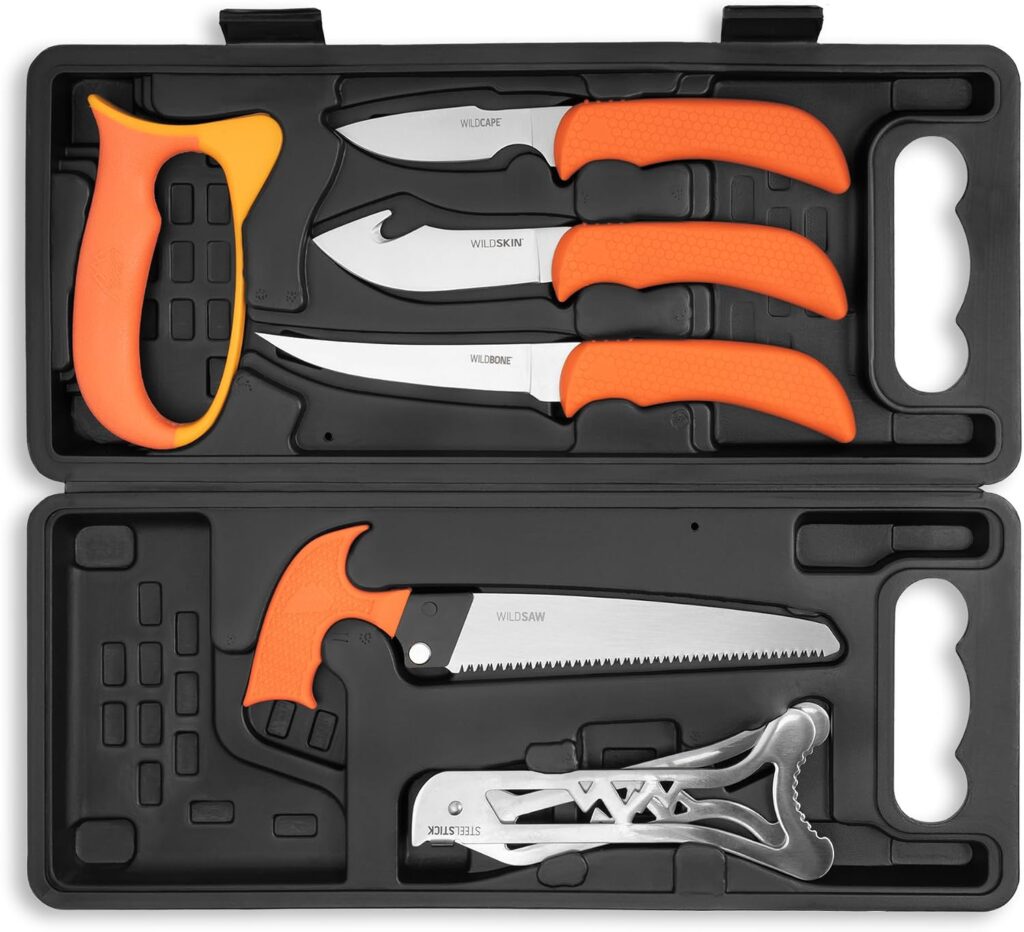
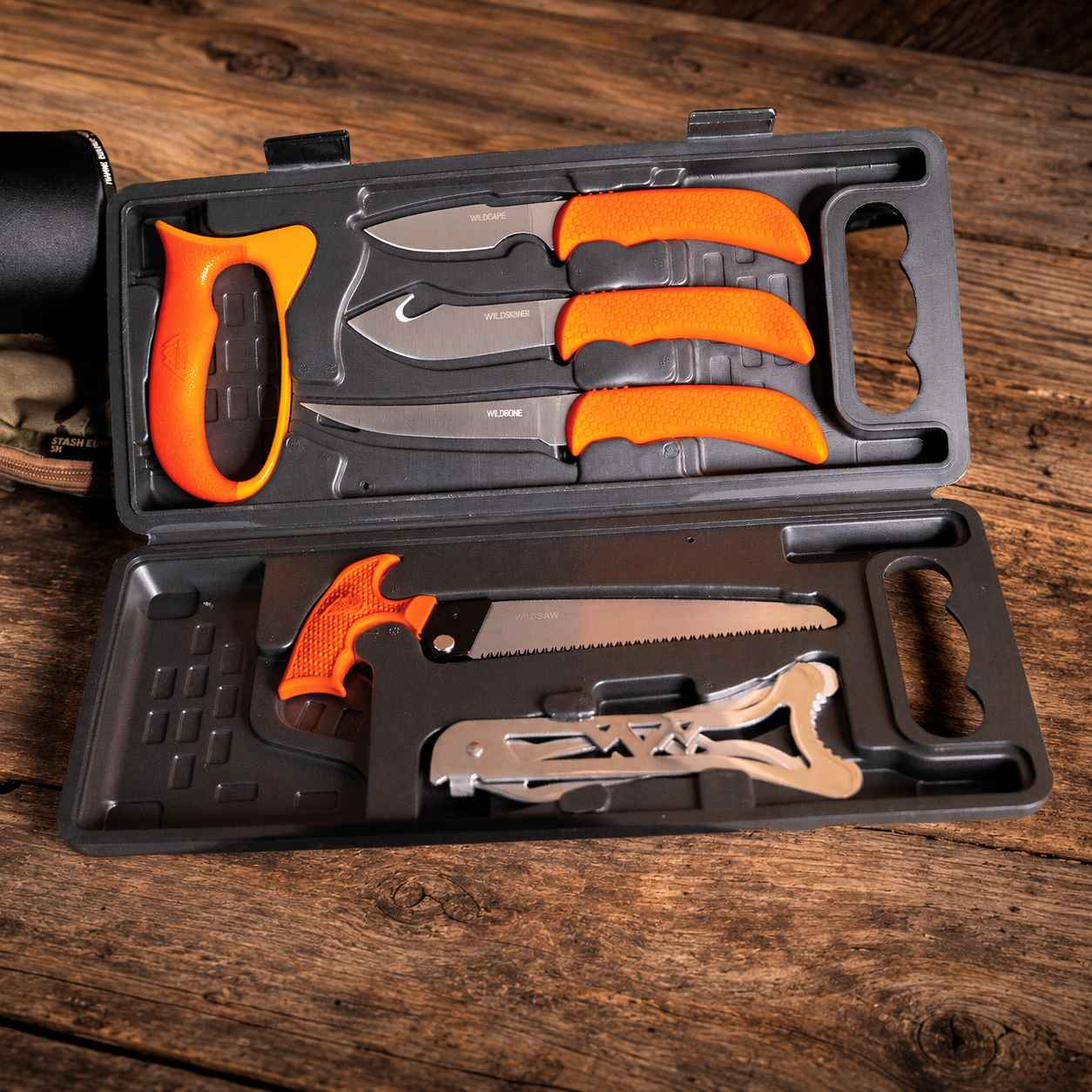
The Outdoor Edge WildPak is the set I’d point a first-time home processor to without much hesitation. It’s built specifically around the field-to-freezer workflow rather than field dressing alone, which is the distinction that matters most here.
What works: The eight pieces cover the full job, a caping knife for detail work around the head and cape, a gut-hook skinner, a boning/fillet knife, a wood/bone saw for splitting the ribcage and quartering, a folding ribcage spreader, a tungsten carbide sharpener, and a pair of cleaning gloves, all in a molded hard-side case. The blades are full-tang 420J2 stainless steel, taper-ground and hand-finished, which gives them a shaving-sharp edge out of the box that holds up reasonably well through a full deer before needing a touch-up. The blaze-orange TPR handles have an elk-horn inlay for extra grip texture, and they stay controllable even when your hands are slick.
Midwest-specific performance: The carbide sharpener built into the kit is genuinely useful here, since Minnesota’s shorter processing windows during firearms season mean you’re often working fast, in a cold garage, without time to run to a full sharpening station between the skinning and boning stages.
The compromise: The boning/fillet knife’s blade is on the stiffer side, which the manufacturer itself has acknowledged makes it less ideal for fish filleting, not a problem if this set stays dedicated to deer, but don’t expect it to double as your ice-fishing kit.
Best for: Hunters who want one set that handles everything from the garage table without buying separate tools piecemeal.
Price: Around $55 at time of writing, verify current price before buying, as retailer pricing shifts seasonally.
➡️ Check Price on Amazon — $49.99 | Check Price at Scheels — $59.99
Best for Home Processing: Outdoor Edge ErgoMax 6-Piece Professional Grade Set
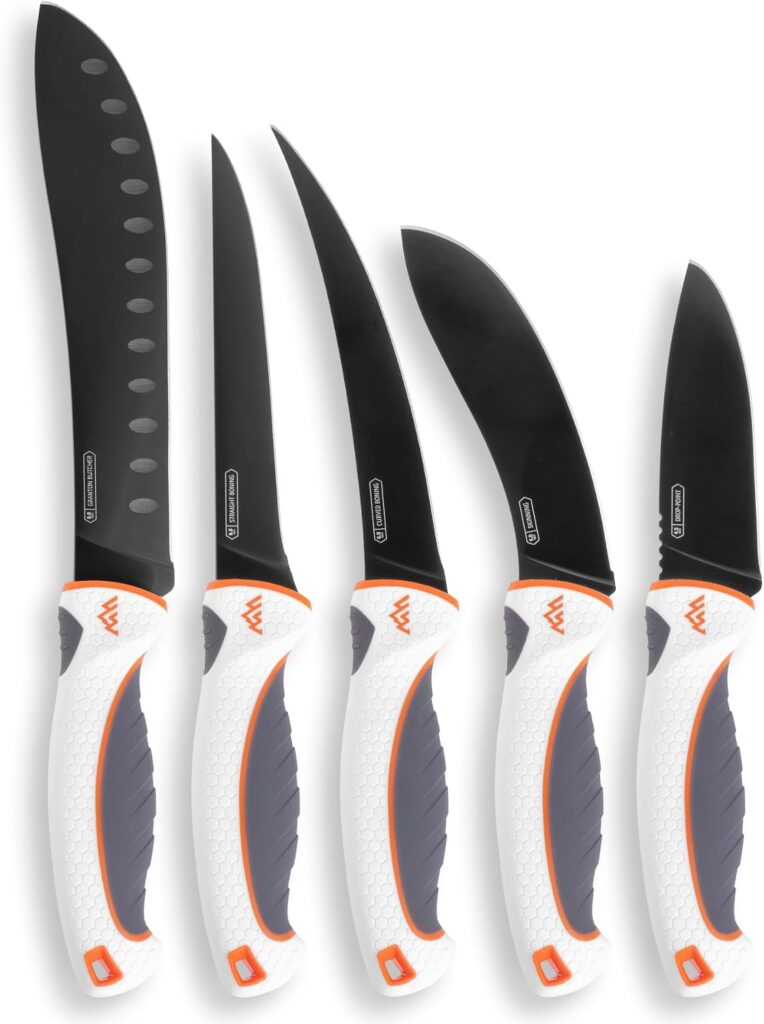
If the WildPak is built for the field-to-freezer hunter who wants one case for everything, the ErgoMax is built more specifically for the home processing table, it trades the saw and spreader for a more complete lineup of actual butchering blades.
What works: The six pieces are an 8-inch Granton-edge butcher knife, a 6-inch straight boning knife, a 6-inch curved boning knife, a 5-inch deep-bellied skinner, and a 4-inch drop-point knife, plus a two-stage sharpener with coarse carbide and fine ceramic stages. The blades use a 5Cr15MoV steel with a black titanium coating, which Outdoor Edge markets for corrosion resistance and reduced friction during cuts, in practice, the coating does make longer slicing motions through muscle noticeably smoother than an uncoated blade of similar steel. The triple-injection ErgoMax handles are the standout feature: they’re genuinely more comfortable through an hour-plus session than the single-shot TPR grips on cheaper sets, and hand fatigue is a real issue when you’re boning out four quarters in one sitting.
Midwest-specific performance: Because this set skips the saw and spreader, it assumes you’ve already done your quartering, which fits a two-stage workflow a lot of Driftless Area hunters already use: rough-quarter in the garage right after the hunt, then do the detailed boning and trimming later at the kitchen table once things have cooled properly.
The compromise: At roughly double the WildPak’s price, and without a saw or spreader included, this isn’t a standalone field-to-freezer kit, you’ll want a saw on hand separately if you’re doing your own quartering from scratch.
Best for: Hunters who already have quartering handled and want a dedicated, comfortable boning-and-trimming setup for the kitchen or basement.
Price: MSRP is $99.99; check current retailer pricing, which sometimes runs below MSRP.
➡️ Check Price on Amazon — $99.99 | Check Price at Scheels — $109.99
Best Budget: Mossy Oak 10-Piece Field Dressing & Game Processing Kit
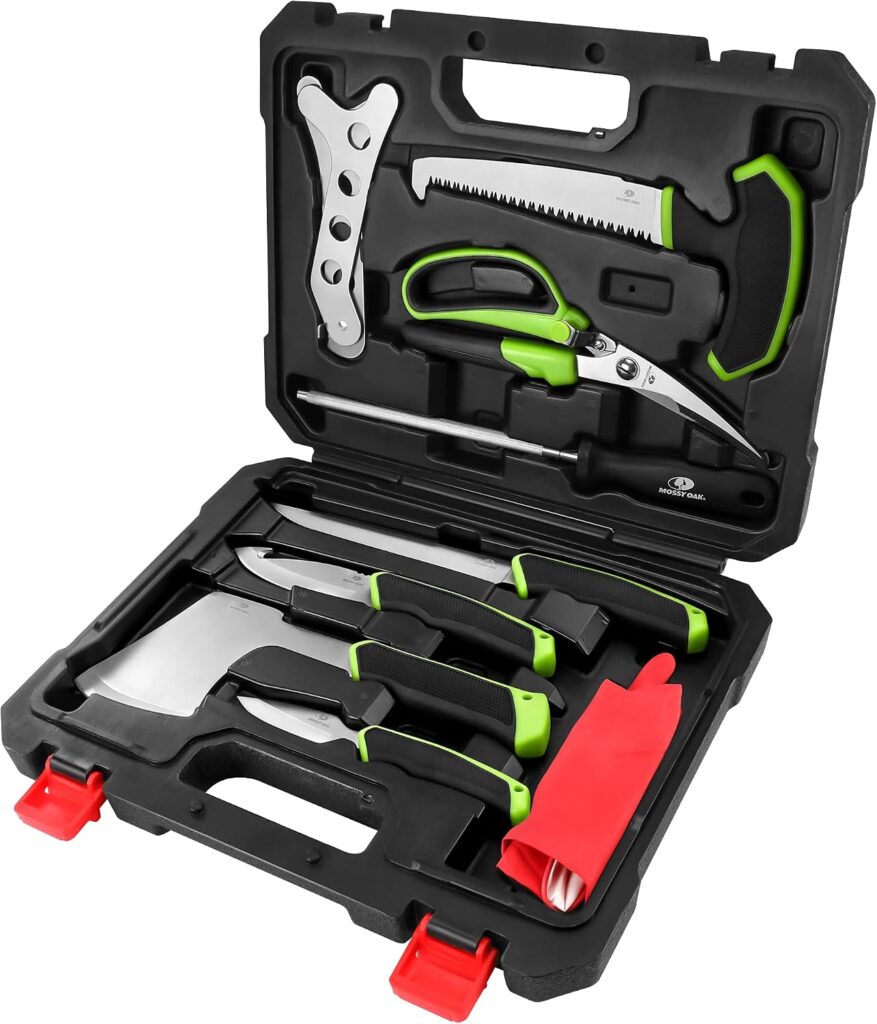
Not everyone processing their first deer wants to spend $100 before they know if they’ll even like doing it themselves. The Mossy Oak 10-piece kit is the set I’d point a genuinely budget-conscious first-timer toward.
What works: This is a loaded kit for the price, a 7¼-inch caping knife, an 8¾-inch gut-hook knife, a 12-inch boning knife, 9-inch game shears, a 9½-inch wood/bone saw, a 10¾-inch butcher knife, a cutting board, a rib spreader, a carbon-steel sharpener, and cleaning gloves, all in a storage case. That’s genuinely more tools than most sets in this price range, and the inclusion of a dedicated cutting board is a nice touch that a lot of competitors skip. The bi-color rubberized handles with an argyle grip pattern hold up fine for non-slip control during a single-deer job.
Midwest-specific performance: For a hunter processing one or two deer a season rather than running a high-volume operation, this kit’s tools are more than adequate, and the lower cost makes it an easy “try it before you commit to premium gear” option, a real consideration for younger or first-year hunters building out their setup on a tighter budget.
The compromise: This is a value kit, and the steel doesn’t hold an edge as long as the pricier Outdoor Edge sets, expect to touch up the blades more frequently mid-job, and don’t expect the bone saw to handle heavy repeated use across multiple animals without needing a blade replacement.
Best for: First-time home processors and budget-conscious hunters doing one or two deer a season who want a complete kit without a big upfront investment.
Price: Typically runs $45–$50 depending on retailer, confirm current price before buying, as third-party marketplace pricing on this kit fluctuates.
➡️ Check Price on Amazon — $47.49
Best Compact/Pack-In: Outdoor Edge Wild Roll Pack 5-Piece Set
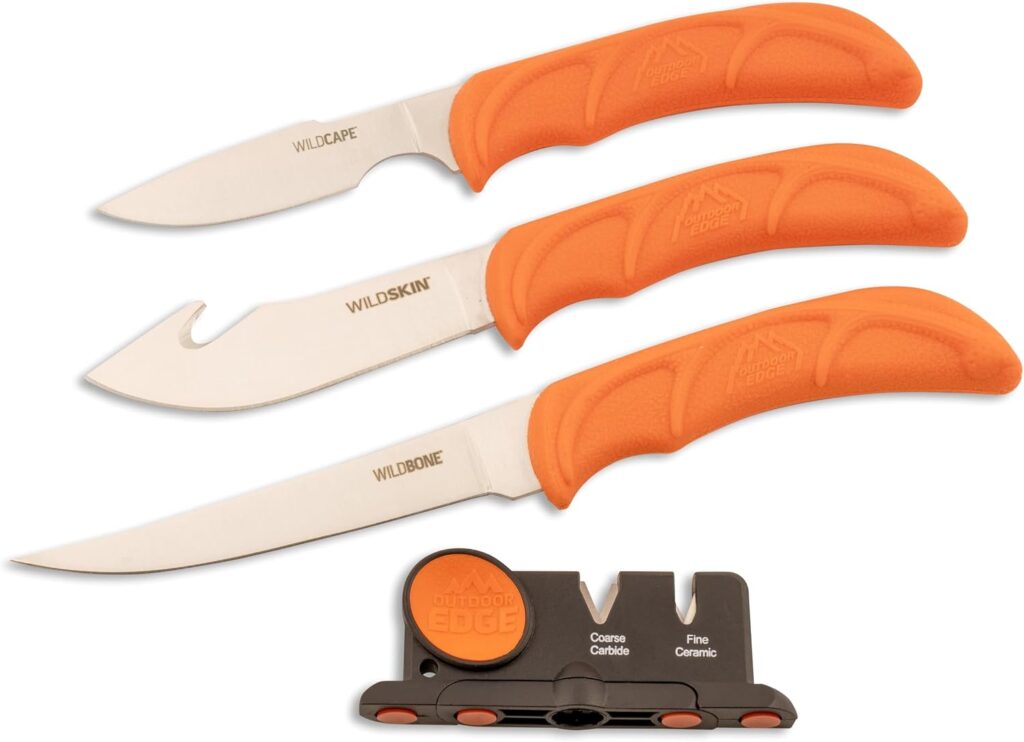
Sometimes you don’t need a hard case taking up shelf space, you need something that rolls up small enough to go in a pack or a truck console and still handles the core processing jobs.
What works: The Wild Roll Pack strips things down to five essentials: a gut-hook skinning knife, a caping knife, a boning blade, and a two-stage carbide/ceramic sharpener, all stored in a compact roll rather than a rigid case. The full-tang 420J2 stainless blades get the same taper-ground, hand-finished treatment as the WildPak, so edge quality out of the box is consistent with Outdoor Edge’s better-known kits. The blaze-orange TPR handles carry over too, which matters for visibility if you’re processing in a dim garage or a low-light wall tent during late-season hunts.
Midwest-specific performance: The compact roll format is genuinely useful for hunters who split their processing between a home garage and a remote hunting camp or cabin, you’re not stuck deciding which case to bring, since this one fits in a duffel without taking up much room.
The compromise: At five pieces, there’s no saw or spreader included, so you’ll need your own solution for splitting the ribcage or quartering large joints, this set assumes some of that heavier work is already done or handled separately.
Best for: Hunters who split time between a home setup and a remote camp, or anyone who wants a slimmed-down kit that doesn’t take up case space.
Price: Typically in the $35–$45 range, confirm current price before buying.
➡️ Check Price on Amazon — $29.99
Best Individual Knives: Victorinox Butcher Knife Set
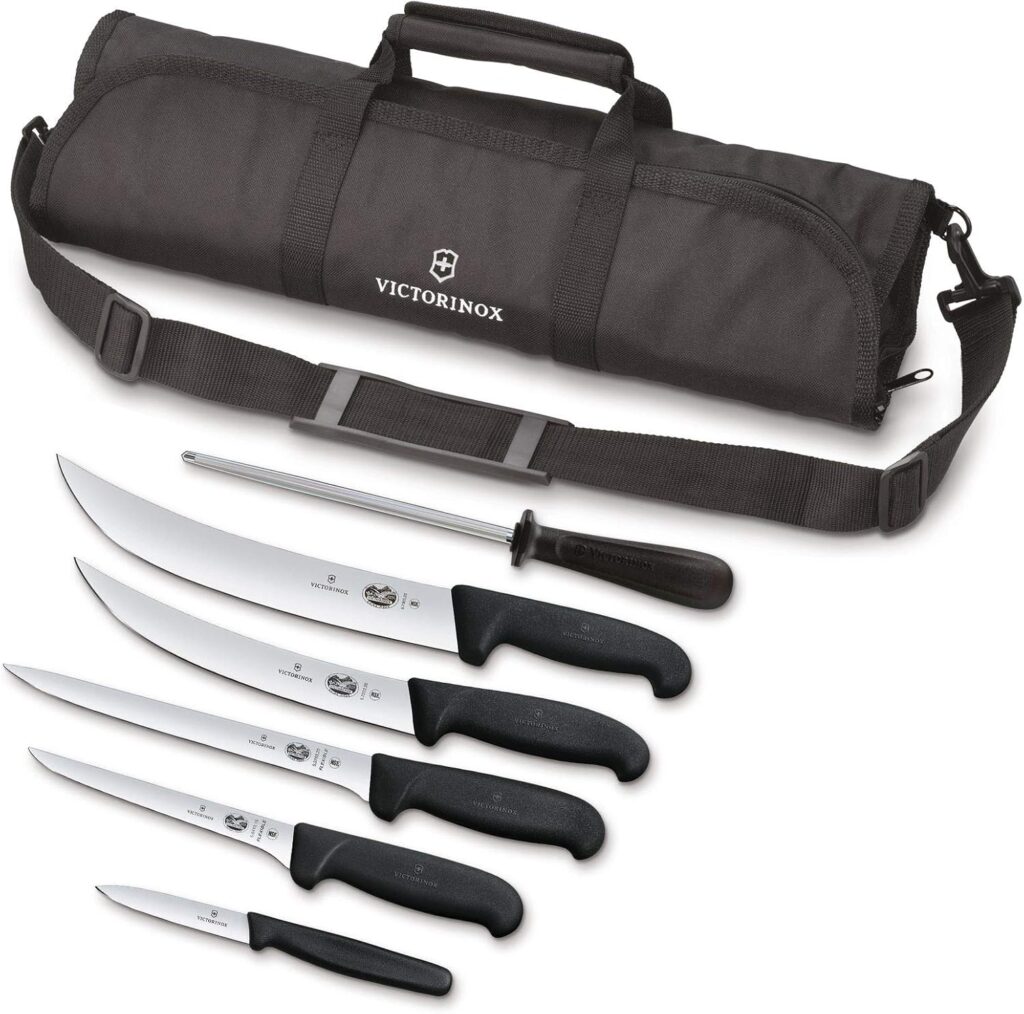
Victorinox doesn’t market itself as a hunting brand, but its Fibrox Pro cutlery line has quietly become the standard a lot of serious home processors upgrade to once they’ve outgrown a starter kit, and the search demand for it backs that up. What a lot of hunters don’t realize is that Victorinox actually sells this as a genuine packaged set built specifically for game processing, not just individual knives you assemble yourself.
What works: The Victorinox Swiss Army Field Dressing Kit is a 7-piece set: a 10-inch Granton-edge cimeter, an 8-inch curved breaking knife, a 6-inch curved boning knife, a 6-inch fillet knife, a 3¼-inch paring knife, a 10-inch honing steel, and a cutlery roll to hold it all. Every blade is high-carbon stainless steel, hand-finished in Switzerland, and mounted on Victorinox’s NSF-certified Fibrox Pro handles, the same non-slip grip used across their commercial kitchen lines. The steel takes a noticeably sharper edge than the 420-series blades in the other sets here, and holds it longer, which is the real reason serious processors gravitate toward this brand specifically.
Midwest-specific performance: The curved 6-inch boning knife in particular earns its search volume, it’s the blade most home processors reach for repeatedly through a full deer, since the curve follows muscle contours during silverskin and fat trimming better than a straight blade does.
The compromise: This is priced meaningfully above the other sets on this list, and it’s a kitchen-cutlery set rather than a hunting-branded kit, no case, no saw, no spreader. You’re buying blade quality, not a complete processing solution, and you’ll want your own saw and spreader alongside it.
Best for: Hunters who’ve processed a few deer already, know exactly which blades they reach for most, and are ready to upgrade steel quality rather than buy another all-in-one starter kit.
Price: Around $150–$180 at time of writing for the full 7-piece kit, verify current price on Amazon, as it fluctuates.
➡️ Check Price on Amazon — $198.99
Comparison Table
| Set | Pieces | Best For | Blade Steel | Includes Saw/Spreader | Approx. Price |
|---|---|---|---|---|---|
| Outdoor Edge WildPak | 8 | Overall / all-in-one | 420J2 stainless | Yes | ~$55 |
| Outdoor Edge ErgoMax | 6 | Home processing table | 5Cr15MoV, titanium-coated | No | ~$100 |
| Mossy Oak 10-Piece Kit | 10 | Budget / first-timers | Stainless (value-grade) | Yes | ~$45–50 |
| Outdoor Edge Wild Roll Pack | 5 | Compact / pack-in | 420J2 stainless | No | ~$35–45 |
| Victorinox Field Dressing Kit | 7 | Upgrade / individual blades | High-carbon stainless | No | ~$150–180 |
How to Choose the Right Butcher Knife Set
Match the Set to Your Actual Workflow
Before comparing price tags, figure out where in the process you actually need help. If you’re doing everything yourself, skinning, quartering, boning, and trimming, all in one sitting, you want a complete kit like the WildPak or the Mossy Oak set that includes a saw and spreader. If you already have a saw and just want better blades for the boning and trimming stage, a dedicated set like the ErgoMax or the Victorinox kit makes more sense, since you won’t pay for tools you already own.
Cost-Per-Use Actually Favors the Better Set
A butcher shop typically charges $75–$150 or more to process a single deer, depending on region and cut complexity. Even the priciest set here pays for itself in one to two deer processed at home, and every set after that is money saved rather than money spent. That math changes how you should think about the ErgoMax or Victorinox upgrade, it’s not really a $100–180 splurge, it’s a tool that’s already profitable by your second season of home processing.
Common Mistakes to Avoid
The biggest mistake is buying a set with too many redundant knives and not enough distinct tools, three slightly different skinning knives don’t help you if nothing in the box handles boning well. The second is skipping the sharpener that comes with most kits and assuming your existing kitchen sharpener will do the job; game-processing blades see harder use in one sitting than most kitchen knives see in a month, and a mid-process touch-up genuinely changes how clean your cuts come out. The third is ignoring handle grip in favor of blade specs, a knife with premium steel and a slick handle is more dangerous in wet conditions than a knife with mediocre steel and a grippy handle.
Knife Performance in Cold-Weather Processing
Cold temperatures affect knife performance in ways that matter here. Some blade steels, particularly harder, thinner-ground ones, get more brittle in extreme cold and are more prone to chipping on bone contact, a bigger factor with premium high-carbon blades like the Victorinox set than with the softer 420-series steel in the budget kits, which is one reason that steel choice persists in hunting-branded gear even though it holds an edge for less time.
Glove dexterity is the other factor: if you’re processing in an unheated garage during a cold snap and wearing even light gloves, a handle that felt grippy bare-handed can feel different with a layer of fabric or nitrile between your palm and the grip, worth testing before you commit to a full processing session in serious cold. And low winter daylight during firearms season, especially if you’re field-quartering before getting the deer home, makes a blaze-orange handle a genuine safety feature rather than just a color choice, it’s far easier to spot a set-down knife in dim light or snow than a black or wood-handled one.
Making Your Knife Set Last
A good set is a one-time purchase if you take care of it. A few habits make the difference between a kit that’s still sharp in year eight and one that’s rusted or dull by year three.
After Every Use
Hand-wash blades immediately after processing rather than letting them sit, blood and fat left on stainless steel for hours, especially overnight, is what actually causes pitting and discoloration, not the steel itself failing. Dry every blade completely before it goes back in the case; a damp blade sealed in a closed case is the single most common way a “stainless” knife still rusts. Wipe down handles too, since dried blood and fat in handle texturing is what eventually makes a grippy handle feel slick.
Sharpening Rhythm
Most of the sets above include a sharpener for a reason, plan on a touch-up partway through a single deer, not just before you start. A few passes on the ceramic or carbide stage between quartering and boning keeps the edge doing the work instead of you. Save a full re-sharpening from scratch for the start of each season rather than mid-job.
Off-Season Storage
If a set is going to sit for months between seasons, a light coat of food-safe mineral oil on the blades before storage prevents surface rust from developing even in a completely dry case. Store the case somewhere with stable temperature and humidity rather than an uninsulated shed, where condensation cycles are worse for the steel than the cold itself.
Bottom Line: Best Butcher Knife Set for Most Home Processors
For most hunters processing their own deer at home, three sets cover the realistic range of needs:
Best Overall: Outdoor Edge WildPak 8-Piece. This is the set to buy if you want one case that handles skinning, quartering, boning, and trimming without assembling separate tools yourself. It’s not the cheapest option and it’s not the highest-end steel, but it’s the most complete answer to “what do I actually need” for a first full home-processing setup, and the price makes it an easy recommendation.
Best Budget: Mossy Oak 10-Piece Kit. If you’re processing one or two deer a season and want to see whether home processing is worth the time investment before spending more, this kit gets you through a full deer with more tools than most kits in its price range, including a cutting board most competitors skip.
Best Upgrade: Victorinox Field Dressing Kit. For hunters who’ve already processed a few deer and know which blades they reach for most, the jump in steel quality is real and noticeable in edge retention through a full animal. It’s not a starter kit, no saw, no spreader, but it’s the set serious home processors eventually gravitate toward.
The worst move is buying a set with a lot of pieces and no distinct tools among them. A tight 5- or 6-piece set where every blade does a different job beats a 12-piece set where three of the knives are nearly identical.
Looking for More?
This guide covers the knife set itself, but a full home butchering setup involves a few more pieces of equipment. Check out our full hub guide, How to Butcher a Deer at Home (Without Screwing It Up), which walks through the entire process step by step, including CWD and lymph-node guidance specific to Driftless Area hunters. If you’re still working through the earlier stage of the process, our guide to field dressing a deer covers what happens before the knife set in this guide even comes into play.
We’re also building out dedicated guides to the rest of a home processing setup, including the best meat grinders, vacuum sealers, dehydrators, and chest freezers for venison, which will link here once published.
FAQs
Not necessarily, but it helps. Skinning wants a thinner, more controlled blade like a caping or gut-hook knife, since you’re working close to the hide without puncturing it, while butchering, boning and trimming, wants stiffer, often curved blades built for separating muscle cleanly from bone and silverskin. Most of the sets above cover both jobs within one kit, which is exactly the point of buying a set instead of a single all-purpose knife. If you’re processing regularly enough to notice friction points in your current workflow, a lot of hunters eventually end up with a complete starter kit like the WildPak for skinning and quartering, plus a dedicated boning set like the Victorinox for the detail work at the end. There’s no rule that says you have to stop at one set once you know which stage of the job you actually want better tools for.
With reasonable care, hand washing and drying immediately after use, occasional honing between deer, and dry off-season storage, a full-tang stainless set like the WildPak or ErgoMax should easily last five to ten years of regular seasonal use, sometimes longer. The blades themselves rarely fail outright as long as they’re not left wet or stored loose against other metal tools. What usually wears out first is the sharpener included in a kit, since the abrasive stages wear down faster than the knives do, or the handle grip losing its texture and non-slip quality after years of repeated washing. If a set starts feeling less controllable in your hand years down the line, it’s often the handle wearing smooth rather than the blade failing.
It depends on how often you’re processing and whether you’ve identified which blades you actually reach for. If you’re doing more than one or two deer a season and find yourself using the same two or three knives repeatedly while the rest of a starter kit sits unused, the Victorinox upgrade is worth it, the steel quality difference is real, and it shows up as noticeably longer edge retention through a full animal rather than needing a touch-up every 20 minutes. If you process one deer a year and your starter kit gets the job done without frustrating you, the upgrade is a nice-to-have rather than a necessity, and that money is better spent on a saw or a vacuum sealer if you don’t already have those.
Yes, with a caveat. Every set in this guide uses blade profiles general enough to handle elk, hogs, and smaller game like turkey or rabbit without needing different tools. The caveat is that elk quartering in particular puts more strain on a bone saw and rib spreader than deer does, simply due to the size and density difference, so the saws included in budget kits like the Mossy Oak set may show wear or need replacement faster if you’re processing elk regularly. For deer, waterfowl, and small game, none of the sets above should need anything extra.
If your chosen set doesn’t include one, the ErgoMax, Wild Roll Pack, and Victorinox kit all skip it, yes, you’ll want a dedicated saw for splitting the ribcage and separating joints at the leg and shoulder. Trying to force a boning or butcher knife through bone is a fast way to chip or dull a good edge, since those blades are ground thin for slicing through muscle and connective tissue, not built to take repeated impact against bone the way a saw’s teeth are designed to. A basic wood/bone saw is inexpensive on its own if you go with one of the sets that leaves it out.
Dry the blades completely before storing them, this matters more than almost anything else for preventing rust, since even “stainless” steel can develop surface rust if it’s sealed wet inside a closed case for months. Apply a light coat of food-safe mineral oil to the blades if the set will sit unused through the off-season, and keep everything in its original case or roll rather than loose in a drawer, where blade edges can nick against other tools or against each other. Store the case somewhere with stable temperature and humidity rather than an unheated shed or garage that goes through repeated freeze-thaw cycles, since condensation from temperature swings does more damage to stored steel than the cold itself.
It’s mostly steel quality and edge retention, but that translates into a real practical difference during a long processing session. A budget set’s 420-series steel starts sharp and cuts fine, but it dulls faster through a full deer, meaning more mid-job touch-ups on the included sharpener. A premium set like the Victorinox kit holds its edge longer through the same job, which means less interruption and a cleaner, more consistent cut on every piece of meat. For someone processing one deer a year, that difference is noticeable but not dealbreaking. For someone processing several animals a season, it adds up to real time saved and fewer inconsistent cuts from a blade that’s quietly gone dull mid-task.
