

Finding the best trail cameras for the money is harder than it should be. The market is flooded with cameras making big claims, huge megapixel numbers, month-long battery life, crystal-clear night vision, and a lot of it doesn’t hold up once the camera is hanging on a tree in October and temperatures start dropping. I’ve bought cameras that were dead by December. Cameras that took a thousand photos of wind-blown grass. Cameras that looked great on the product page and produced blurry garbage at night. Most of that money came back as a lesson.
I run eight cameras across a couple of properties in Minnesota. Some of that ground is river bottom timber, some is ag edge, and none of it is forgiving on gear. Cold kills batteries, Dense canopy wrecks cellular signal. The cameras that earn a spot on my trees are the ones that keep working through all of it, not just through September when the weather is easy.
This list covers six cameras: three SD card cameras you pull manually, and three cellular cameras that send photos to your phone. All six were picked because they deliver more than the price tag suggests. The cheapest one here is $58. The most expensive is $178. Every one of them has pulled photos of deer in bad conditions, and every one of them has at least one honest trade-off I’m going to tell you about.
Whether you’re buying your first trail camera or adding to a setup you’ve been running for years, this guide gives you what you actually need to make the right call, without wasting money on specs that don’t matter in the field.
What Makes a Trail Camera Worth the Money?
A trail camera lives outside in the dark for months at a time. What it does well, and where it lets you down, usually comes down to four things: image quality, trigger speed, battery life, and how well the housing holds up. Manufacturers love to talk about the first two. The last two are where cheap cameras quietly fail, and where good budget cameras quietly earn their keep.
Those Megapixel Numbers Are Mostly Marketing
Here’s something the box won’t tell you: most budget trail cameras have a basic image sensor that produces far fewer megapixels than the number printed on the label. The higher number, 48MP, 64MP, whatever, gets there because the camera’s software pads the photo file to look bigger on paper. The end result takes up more space on your SD card and loads more slowly, but the actual photo isn’t any sharper. TrailCamPro, which has been independently testing trail cameras longer than most brands have existed, has documented this pattern across dozens of cameras over the years.
What actually matters is the quality of the sensor itself. The Sony Starvis sensor inside the GardePro A3S is genuinely better than the generic sensors most cameras at this price use, not because of any number on the label, but because it captures more detail in low light. That’s the difference you’ll actually see when you pull the card in November.
Trigger Speed — What It Costs You When It’s Slow
Trigger speed is the gap between when the camera’s motion sensor detects something and when the shutter fires. On a budget camera that gap can run anywhere from 0.1 seconds to well over a second. It sounds like nothing. On a trail where a deer is walking through at a normal pace, it’s the difference between a full body shot you can actually use and a photo of a white tail disappearing off the left edge of the frame. If you’ve ever pulled a card and found a hundred pictures of empty trails with no explanation, a slow trigger is usually the answer.
For cameras going on active travel corridors, I want 0.5 seconds or faster. Anything slower belongs on a food plot or bait pile where the deer will stand still long enough for it not to matter.
Cold Weather Is Where Battery Claims Fall Apart
Every manufacturer tests battery life at room temperature under ideal conditions. Those numbers don’t survive a Minnesota January. Cold weather drains batteries significantly faster, alkaline batteries especially. Pull a camera off a tree in February after three weeks of sub-zero nights and you’ll often find a dead battery tray and no photos from the last stretch of the rut. Lithium batteries, Energizer Ultimate Lithium specifically, hold their charge dramatically better in the cold. The National Renewable Energy Laboratory has published research confirming that lithium battery chemistry maintains performance at temperatures that effectively shut down alkaline batteries.
The fix is simple: run lithium batteries from October through March if you’re anywhere north of the Iowa border. It adds $10–$15 per camera per season. It’s the single cheapest upgrade you can make to your whole setup.
Know the Rules Before You Buy Cellular
This one matters and a lot of hunters miss it. Several Midwest states now restrict or ban cellular trail cameras during deer season. Iowa’s ban is the most talked-about in our region, real-time transmitting cameras are not legal for deer hunting there. Wisconsin, Michigan, and other states have debated or passed similar rules, and the landscape keeps shifting. Always verify your state’s current regulations through your DNR before you deploy a cellular camera. The National Deer Association maintains a state-by-state tracker on cellular camera regulations that’s worth checking every year. Getting caught with an illegal camera is an easy way to ruin a season.
Buy Multi-Packs and Cover More Ground
One camera on your best trail tells you almost nothing about what your property is actually doing. The hunters who kill the best deer consistently are the ones running enough cameras to understand movement, not just the one funnel they think is the best. The budget two-packs and three-packs on this list make the math work. Three cameras at $43 each covering three different pinch points beats one $130 camera on a single tree every time. Cover ground first, then invest up when you know where the deer actually are.
Our Picks at a Glance
Best Overall Bang for the Buck (SD): Muddy Pro Cam 14 — 3 Pack — $129.99 Best Overall Image Quality (SD): GardePro A3S — 2 Pack — $107.99 Best Budget Pick (SD): Spypoint Force-48 — $58 Best Cellular Value Overall: Moultrie Edge 3 — 2 Pack — $149.99 Best Budget Cellular Deal: Spypoint Flex-M — 2 Pack — $129.99 Best Solar-Ready Value: Spypoint Flex-S Dark — $177.99
Best Non-Cellular SD Card Trail Cameras
1. Muddy Pro Cam 14 — 3 Pack | Best Overall Bang for the Buck
➡️ Check Price on Amazon — $129.99
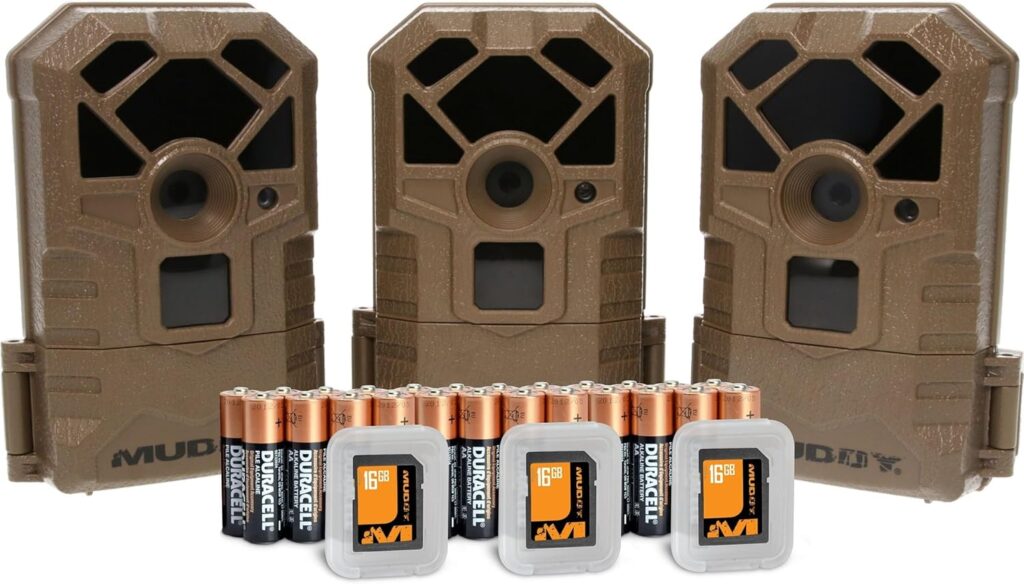
The Muddy Pro Cam 14 three-pack is what budget trail camera buying was always supposed to look like. For under $130, you get three cameras, batteries, and SD cards, ready to hang right out of the box. No separate trip to the store, no scrambling for a memory card the night before opening weekend. You grab the box, head to the property, and start covering ground.
Each camera shoots 14-megapixel photos by day and switches to monochrome at night, with 18 infrared LEDs reaching 50 feet in the dark. Trigger speed on the current model is 0.7 seconds, fast enough for deer walking a trail directly in front of the camera, though you’ll occasionally catch a rear quarter shot on animals moving through at an angle. Detection range runs 50 to 80 feet depending on which version you’re running. Video records at 480p, adjustable from 10 to 60 seconds. Every image gets stamped with date, time, temperature, moon phase, and camera ID, which matters when you’re pulling cards from eight different setups and need to keep locations straight.
What hunters in the field consistently report is excellent battery life. The camera runs on 6 AAs, and users who own ten, fifteen, or more of these cameras, and there are quite a few of them, specifically call out how long a set of batteries lasts under normal activity. That’s the most relevant testimony for a guy running cameras across multiple farms in the river bottom, where pulling cameras every few weeks just to swap batteries gets old fast.
The trade-off is night image detail. You’ll see a deer, you’ll get a sense of body size and basic antler shape, but you’re not counting points clearly at 50 feet in the dark. Some hunters on Midwest forums have noted inconsistent detection on animals that came in from the edges of the detection zone rather than straight in front. At $43 per camera with everything included, that’s an acceptable limitation for coverage cameras. These belong on travel corridors and transition zones where the number of locations you cover matters more than squeezing every detail out of each individual photo.
Best for: Hunters covering large properties who need multiple cameras at once, first-timers building a starting setup, anyone who wants a plug-and-play kit without buying accessories separately.
Price: $129.99 (3-pack with batteries and SD cards)
2. GardePro A3S — 2 Pack | Best Overall Image Quality
➡️ Check Price on Amazon — $107.99
The GardePro A3S is the camera that changed how I think about budget trail cameras. When an independent testing site that has been evaluating cameras for over twenty years, TrailCamPro, calls it the first sub-$100 camera they’ve ever fully backed with a warranty recommendation, that means something. They don’t hand that out often.
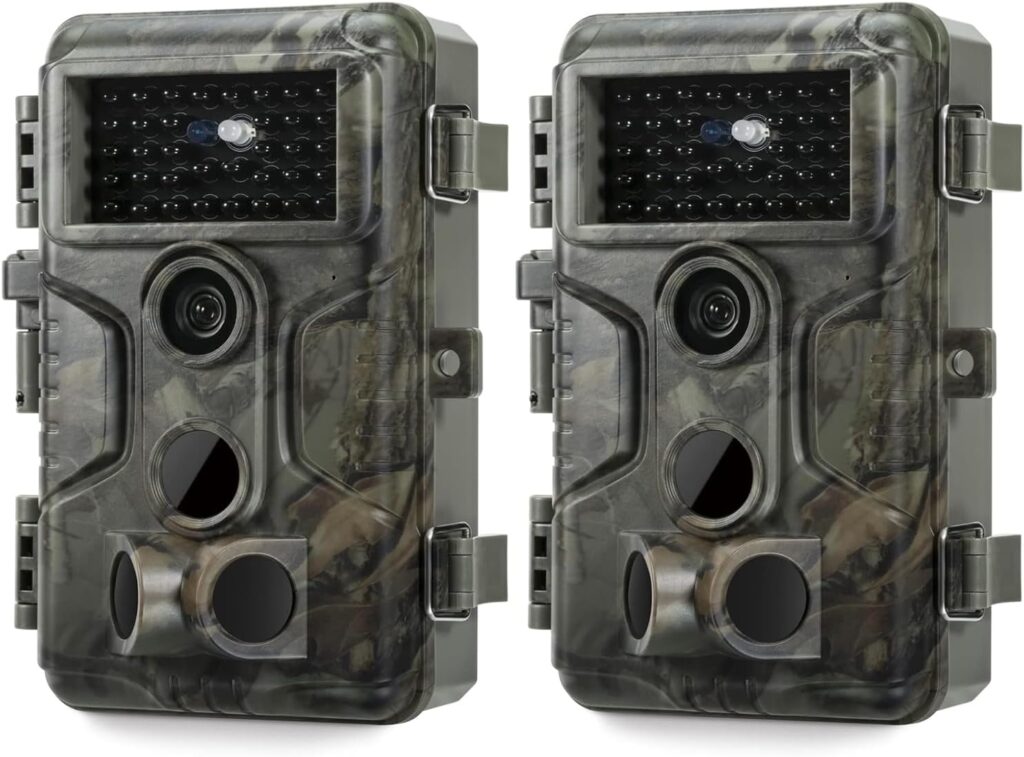
What separates the A3S from everything else at this price is the Sony Starvis sensor. Most budget cameras use basic image sensors that struggle in low light. Sony’s Starvis technology was built for security cameras operating in near-darkness, and it shows in every card pull. In blind testing the A3S produced nighttime images sharper and brighter than cameras costing twice as much. It won TrailCamPro’s 2022 Flash Range Shootout outright, beating every camera in the field. TechGearLab named it their best budget camera pick and noted it was the only model in their entire test that detected motion at 100 feet both during the day and at night. That coverage area, 120 degrees across three motion sensors, is unusually wide for anything near this price.
The full spec sheet is strong: 64MP photos, 1296P HD video, 0.1-second trigger speed, 100-foot no-glow night vision, and an IP66 waterproof rating. The no-glow infrared array produces zero visible light when the shutter fires. On pressured properties where deer have been hunted hard and learned to associate cameras with danger, that matters. The camera supports SD cards up to 512GB, accepts a separately sold solar panel for extended deployment, and has a 2.4-inch color screen that makes in-field programming far easier than the tiny monochrome screens on most cameras at this price.
Here’s the honest part: battery life on the A3S varies significantly depending on how you set it up. Multiple reviewers have documented that running the camera at medium or high motion sensitivity in windy conditions, an October morning in a hillside draw in the Driftless Area, produces thousands of false triggers that drain batteries in days. Set it to low sensitivity in photo-only mode and battery life is excellent. This is easy to manage once you know about it, but it bites hunters who set the camera and don’t check it for three weeks. Know the setting before you hang it.
Best for: Hunters who prioritize image quality above everything else, cameras placed on known scrapes or rubs where every photo counts, anyone hunting pressured properties where a visible flash has already pushed deer off a location.
Price: $107.99 (2-pack)
3. Spypoint Force-48 | Best Budget Pick
➡️ Check Price on Amazon — $58
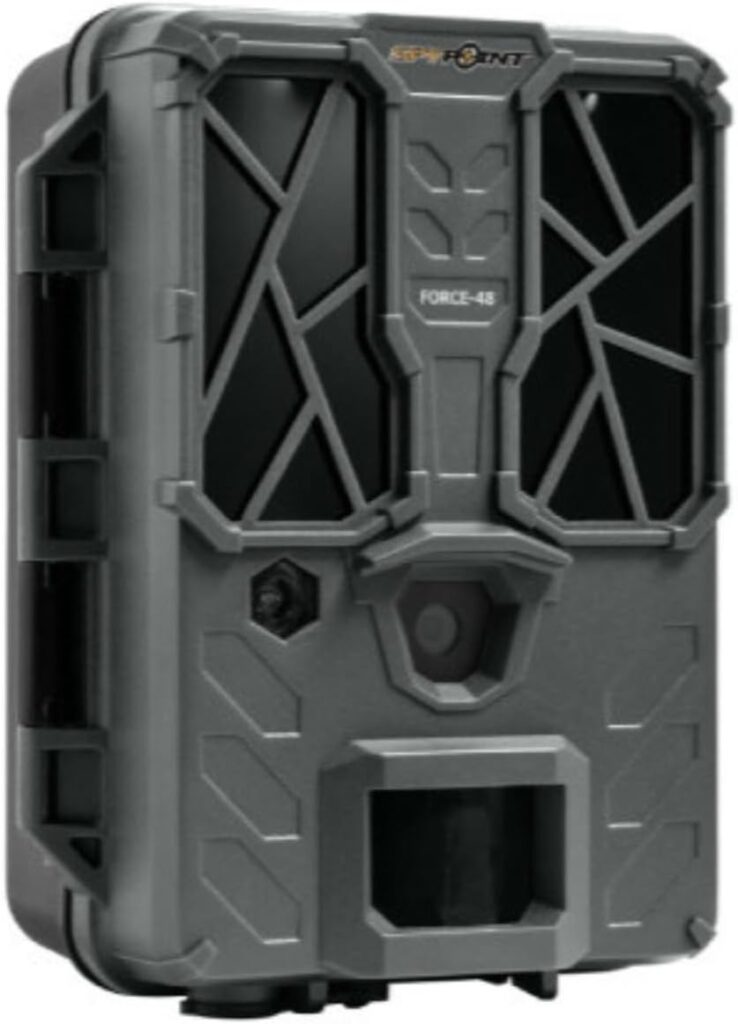
At $58, the Spypoint Force-48 belongs in one specific category: the camera you put somewhere you can’t fully protect. That’s not an insult, it’s a real job description. Every serious deer hunter has locations where theft is a genuine risk. Public land. Permission ground where other people walk through. Timber parcels you can’t monitor closely. You don’t put a $180 camera there. You put a Force-48 there, run a cable lock through the Python latch, and accept that if it disappears, you’re out $58 and nothing more.
For the price, Spypoint built this camera around the right priorities. The 48-LED, low-glow infrared array delivers a genuine 80-foot flash range, better illumination than you’d expect from the price tag. Trigger speed is 0.5 seconds, which is adequate for most trail applications. The camera shoots 48MP photos and 720p video with sound, and supports up to five photos per detection event so you don’t miss an animal moving through on the edge of the frame. Three capture modes cover every standard use case, photo, video, and time-lapse. The Time-Lapse+ mode is worth calling out: it’s useful for monitoring food plots or cut cornfields where you want to see overall movement patterns during shooting hours, not just individual trigger events.
Field & Stream called the Force-48 a “solid, workhorse camera for the woods at a really great price” after running it alongside significantly more expensive cameras in a head-to-head test. Day photo quality is genuinely good. Night photos on stationary or slow-moving animals are clear. Fast-moving deer at night will produce some blur, that’s a limitation of what the flash hardware can do at this price, not a flaw unique to this camera.
One thing to know before you buy: the Force-48 does not include an SD card. Budget another $8–$12 for a 32GB card. Spypoint recommends their own branded card, and at least one reviewer documented a compatibility issue with a SanDisk Ultra card that went away immediately after switching to the Spypoint card. Minor hassle, but worth knowing before you’re standing in the dark wondering why the camera won’t write.
Best for: Public land setups, high-theft-risk locations, secondary coverage cameras on large properties, first-time camera buyers who want to start cheap and learn before spending more.
Price: $58
Best Cellular Trail Cameras For The Money
One thing to understand before you pick a cellular camera: the camera is only part of the cost. Every cellular camera needs a data plan to transmit photos to your phone. Spypoint includes 100 free photo sends per month with their cameras, which covers light to moderate use. Moultrie’s plans start at $9.99 per camera per month with no contract. If you run four cellular cameras from August through January, that’s $240–$360 in plan costs on top of whatever you paid for the cameras. Some hunters find that entirely worth it. Others do the math and go back to SD card cameras. Know what you’re signing up for before you commit.
4. Moultrie Edge 3 — 2 Pack | Best Cellular Value Overall
➡️ Check Price on Amazon — $149.99
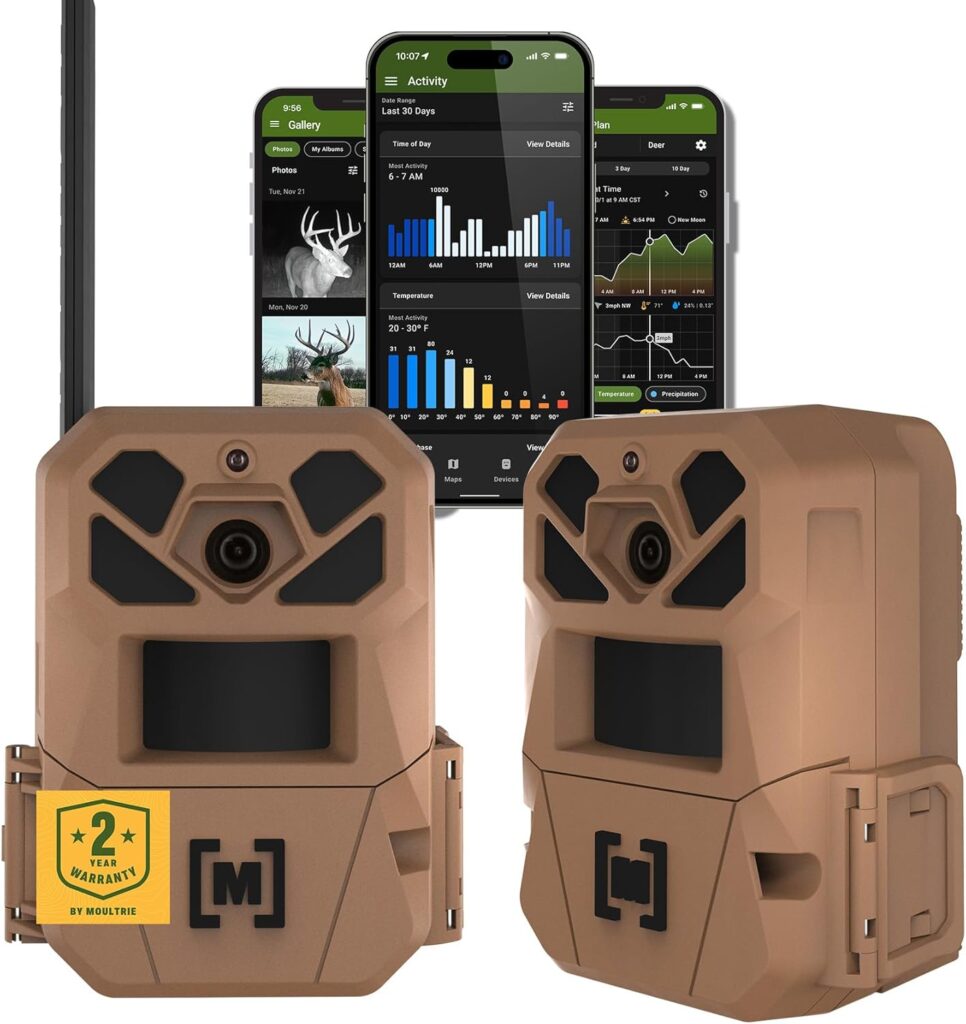
The Moultrie Edge 3 two-pack is the best dollar-per-camera deal in the cellular category right now. At $75 per camera with the full Edge 3 feature set, it undercuts what competing cameras charge for similar performance. Moultrie has iterated on the Edge platform through three generations, each one adding things that actually matter in the field rather than spec bumps for the box, and the Edge 3 is where that work pays off.
The camera shoots 40MP photos and 1080p video with sound, using a low-glow infrared flash with 100-foot detection range. Trigger speed is 0.5 seconds. The four-carrier auto-connect is worth understanding before comparing it to competitors. Most cellular cameras lock to one or two networks, which means you need to know your coverage situation before buying. The Edge 3 scans all four major U.S. networks and automatically connects to whichever one has the best signal at your exact location. In southern Minnesota, where one farm might run strong on Verizon and the next property over does better on AT&T, that matters more than it sounds on paper. You hang the camera, it figures out the network on its own, and it works.
The 2025 additions are genuinely useful rather than marketing padding. Live Aim lets you preview exactly what the camera sees through the Moultrie app before you finalize placement, no more guessing whether you’re aimed at the right height or whether that branch on the left is going to trigger false photos all fall. Moultrie AI identifies species automatically and flags buck detections with immediate high-resolution alerts, cutting down the time you spend scrolling through squirrels and does to find the shooter that walked through at 6 AM. Power Metrics monitors your connection and alerts you if a solar panel cable isn’t properly seated, which prevents the silent failure problem where a camera dies quietly and you don’t find out for two weeks.
Built-in memory means no SD card required. Photos sync directly to the Moultrie app’s cloud storage, which is one fewer piece of equipment to lose in the field and one fewer compatibility issue to troubleshoot. The camera also ties into Moultrie feeders through the Connect platform, letting you manage feeding schedules and camera photos from the same app. If you’re already running Moultrie feeders on a managed property, common across the Midwest, that integration is genuinely convenient. Plans start at $9.99 per camera per month with no contract required.
Best for: Hunters managing multiple properties or lease ground far from home, anyone already running Moultrie feeders who wants a unified scouting platform, hunters who want multi-carrier coverage without thinking about which network to choose.
Price: $149.99 (2-pack)
5. Spypoint Flex-M — 2 Pack | Best Budget Cellular Deal
➡️ Check Price on Amazon — $129.99
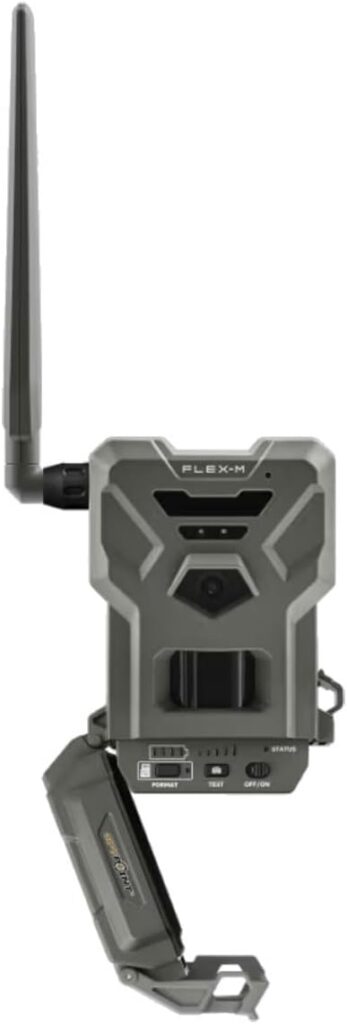
At $65 per camera, the Spypoint Flex-M is what happens when a cellular trail camera gets the important things right without overcomplicating the rest. In TrailCamPro’s 2024 cellular camera shootout, 25 cameras tested head to head, the Flex-M ranked first in flash range and second in detection speed. Cameras costing significantly more finished behind it. That comes from independent testing, not a manufacturer’s press release.
The Flex-M shoots 28MP photos and 720p video with sound. Trigger speed is 0.4 seconds. Detection range hits 90 feet day and night. The dual-SIM design automatically selects the strongest of two network connections, which matters most in fringe coverage areas. One reviewer testing the camera in a location with only one bar of LTE reported it still transmitted deer photos reliably, other more expensive cameras tested alongside it failed in the same spot. For hunters running cameras in river bottoms, hillside draws, or any location where signal strength is marginal, that real-world flexibility is worth more than any spec on the box.
GPS is built in and pins each camera’s location on the Spypoint app’s map, which is useful when you’re running cameras across multiple farms and can’t always remember exactly which tree has which setup. Battery life sits around 3.3 months on quality lithium batteries running moderate activity, solid for a cellular camera, since the modem draws power around the clock even when it’s not sending photos. Spypoint’s rechargeable lithium battery pack extends runtime meaningfully for cameras in high-traffic locations. One note: the Flex-M uses a Micro SD card rather than a standard SD. Have the right card on hand before you head out.
The one thing reviewers consistently flag is the antenna, it’s external, threads on and off easily, and it’s the most fragile part of the design. Take it off when you’re moving the camera in a pack. It’s a two-second step that prevents a headache in the field.
Best for: Hunters buying into cellular cameras for the first time, public land setups where keeping per-unit cost low matters, anyone hunting in marginal signal areas who needs dual-SIM flexibility to stay connected.
Price: $129.99 (2-pack)
6. Spypoint Flex-S Dark | Best Solar-Ready Value
➡️ Check Price on Amazon — $177.99
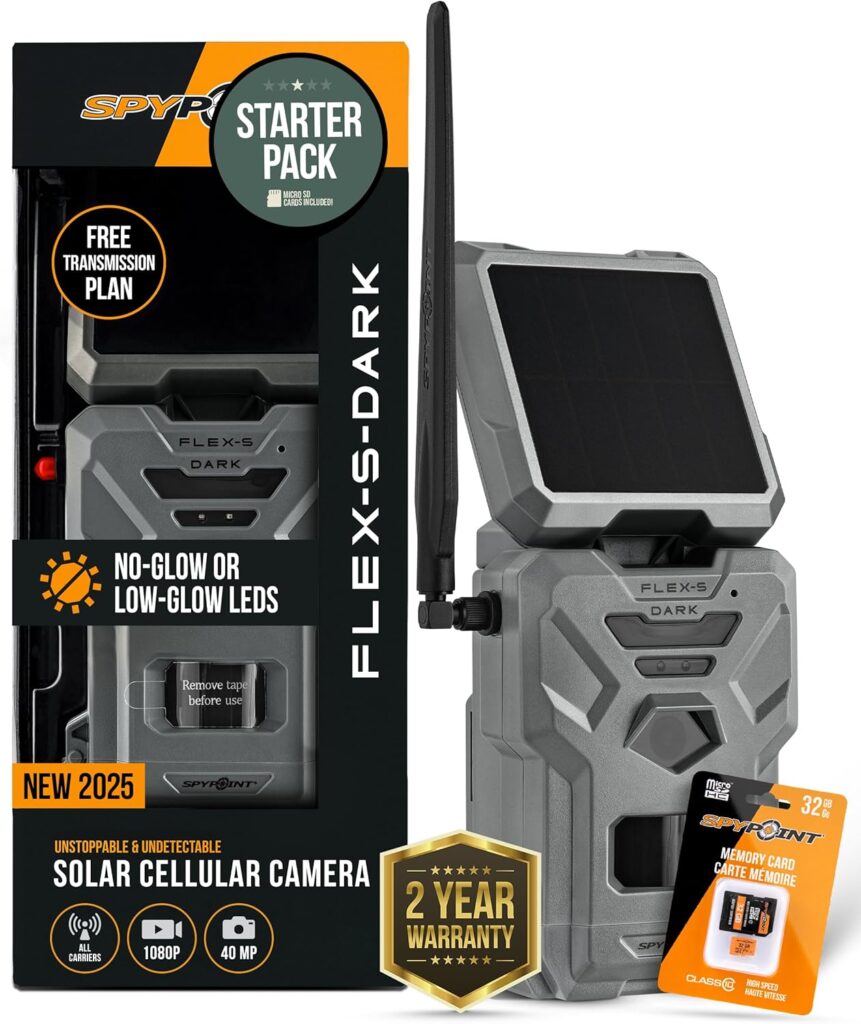
The Spypoint Flex-S Dark solves one specific problem better than anything else on this list: you found the right spot, but getting there to change batteries means burning a scent trail through your best bedding area. The built-in solar panel with integrated internal battery handles that. You hang it in August, set it, and you don’t go back until season ends.
The “Dark” in the name refers to the LED options. You can run it in true no-glow mode, zero visible light when the shutter fires, or dial back to low-glow depending on the location and situation. That flexibility is useful. Some spots warrant full concealment; in others it doesn’t matter either way. The camera’s specs are competitive across the board: 40MP photos, 1080p video with sound, 0.3-second trigger speed, and 90-to-100-foot detection and flash range. It ranked first overall in TrailCamPro’s 2024 Cellular Camera Detection Shootout against a field of 25 cameras, the tests that matter most to hunters.
The solar panel’s real-world performance in Midwest conditions is the defining feature, and the documented results are remarkable. One hunter running a previous-generation Flex-S in a South Dakota river bottom, with temperatures hitting -29°F in January, reported the internal battery at 100% after seven months in the field and nearly 2,000 transmitted photos. That’s not a manufacturer’s claim. That’s a screenshot from the app taken the following March. In Minnesota, where a camera fighting sub-zero nights from November through February is working against everything that kills batteries, a solar panel that sustains charge through a genuine Upper Midwest winter changes what long-term deployment looks like entirely.
I’ll be straight about the trade-offs. The Flex-S Dark has drawn some reliability complaints from early buyers, cameras stopping transmissions after firmware updates, and a minority of units with solar charging issues at first deployment. Spypoint’s customer service response on these issues has been inconsistent based on what users report online. It’s not a universal problem, but it’s real enough to say plainly. This camera makes the most sense on two or three specific locations where the no-battery-change benefit genuinely earns the premium. The Flex-M handles everywhere else.
Best for: Remote stand locations where battery changes mean walking through core hunting areas, hunters running cameras from August through February without mid-season visits, anyone who lost key scouting intel from a dead camera last January and doesn’t want it to happen again.
Price: $177.99
Comparison Table
| Camera | Type | Price | MP | Trigger Speed | Night Range | Battery | Best For |
|---|---|---|---|---|---|---|---|
| Muddy Pro Cam 14 (3-pack) | SD Card | $129.99 | 14MP | 0.7s | 50 ft | 6 AA | Volume coverage, plug-and-play setup |
| GardePro A3S (2-pack) | SD Card | $107.99 | 64MP (Sony Starvis) | 0.1s | 100 ft no-glow | 8 AA | Best image quality under $60/cam |
| Spypoint Force-48 | SD Card | $58 | 48MP | 0.5s | 80 ft low-glow | 8 AA | Public land, theft-risk locations |
| Moultrie Edge 3 (2-pack) | Cellular | $149.99 | 40MP | 0.5s | 100 ft low-glow | Built-in + AA | Multi-property, feeder integration |
| Spypoint Flex-M (2-pack) | Cellular | $129.99 | 28MP | 0.4s | 90 ft | 8 AA | Best budget cellular, dual SIM |
| Spypoint Flex-S Dark | Cellular | $177.99 | 40MP | 0.3s | 90–100 ft no-glow | Solar + 8 AA | Remote deployment, season-long run |
SD Card vs. Cellular: Which One Is Right for You?
This is the real decision, and it depends on your hunting situation more than your budget.
Choose an SD Card Camera If…
Your state restricts cellular cameras during season, Iowa’s ban is the most significant example in our region, but regulations are shifting constantly and worth verifying every year before you hang anything. SD card cameras are also the right call when your property has poor cellular coverage. A cellular camera with no signal is just an expensive SD card camera that burns through batteries faster, because the modem keeps searching for a network that isn’t there.
SD card cameras also make straightforward financial sense when you’re running a lot of cameras. Eight SD card cameras cost far less annually than eight cellular cameras once you factor in monthly data plans. The only real cost is the scent pressure you create pulling cards, which is why your approach route matters as much as the camera itself. The National Wild Turkey Federation and wildlife biologists broadly have documented that reducing human intrusion near sign areas improves hunting success, and minimizing card-pull trips is part of that equation on pressured ground.
Choose a Cellular Camera If…
You have reliable coverage, you want to know what’s on your property without walking in, and you’ve done the plan cost math honestly. The scouting value is real. When that gnarly 8-point you’ve been watching all summer shows up at your scrape on November 4th at 6:30 PM, you know about it at 6:32 PM, not next weekend when you pull the card. For managing lease ground you can’t check frequently, or for timing a move on a specific buck during the rut when a 48-hour window can make or break a season, cellular cameras pay for themselves. Just make sure the coverage is actually there before you buy the hardware.
How to Choose the Right Trail Camera
Know Your Coverage Before You Buy Cellular
Drive to your property and check signal strength on your own phone from the specific tree locations where you plan to hang cameras. One bar of LTE is marginal. If it’s marginal on your phone, assume it’s worse on the camera. Buy an SD card camera for that spot instead.
Match Trigger Speed to the Location
Cameras on active travel corridors need 0.5 seconds or faster. Cameras on food plots, scrapes, or bait stations where deer mill around can work fine with a slower trigger. Don’t pay extra for a 0.1-second trigger to put it over a mineral lick where deer stand for twenty minutes at a time.
Plan for Winter From the Start
Alkaline batteries will let you down in January. Budget for lithium batteries from October onward, they hold their charge in cold weather where alkalines quit. Add $15–$20 per camera per season and stop thinking about it. For cellular cameras, the modem running around the clock compounds the cold-weather battery problem significantly. This is part of why the Flex-S Dark’s solar panel earns its price premium on northern properties that stay cold into February.
Think About Theft Risk Honestly
On any property with public access or shared boundaries, run a camera you can afford to lose. A stolen Force-48 at $58 stings. A stolen Flex-S Dark at $178 makes you question your decision-making. Cable locks through Python latches are standard deterrents, not guarantees. Keep your budget cameras on exposed locations and your better cameras on interior spots only you know about.
How Often Can You Actually Check Cameras?
SD card cameras are only as good as how often you pull them. If you’re three hours from your property and can only get out once a month, a cellular camera pays for itself in intel you’d otherwise miss entirely. If you’re fifteen minutes from home and check cameras every two weeks, SD card cameras are fine and cost you nothing in monthly plans.
Common Mistakes Worth Avoiding
Buying a cellular camera without checking state regulations first is the most expensive mistake on this list. Running alkaline batteries through a Midwest winter and assuming the camera is still pulling photos is a close second. And testing a new camera at home before it goes on a tree is a step most hunters skip once and never skip again.
Trail Camera Placement Tips for the Midwest

Work Wind Into Your Card-Pull Strategy
Every time you walk to a camera to pull the SD card, you leave human scent at or near that location. In pressured country, most Midwest public land and a lot of shared private ground qualifies, deer pattern human intrusion faster than hunters realize. Plan your approach the same way you plan a stand approach: from downwind of the core travel area. If that isn’t possible, it’s a strong argument for going cellular and eliminating the card-pull visit entirely.
Camera Height and Angle Matter More Than People Think
Most hunters hang cameras at chest height pointing straight out. That works, but it produces a lot of photos with deer half out of the frame on angled approaches. Hanging a camera at knee to waist height and angling it slightly downward produces better full-body shots and gives you a cleaner look at antler characteristics. The Moultrie Edge 3’s Live Aim feature is genuinely useful here, you can confirm your framing from the app before leaving the tree, rather than finding out three weeks later that you were aimed six inches too high the whole time.
Face Cameras South When You Can
This matters more in Minnesota than most guides bother to mention. A camera mounted on the north side of a tree with its detection zone facing south catches direct morning sun heating the air in front of the lens, which can produce false triggers on cold mornings. South-facing cameras also stay marginally warmer in cold weather, which helps battery performance. And if you’re running a solar camera like the Flex-S Dark, south-facing exposure is critical to keeping that panel effective through a real Midwest winter.
Looking for More
Trail cameras are only part of getting ready for Midwest deer season. If you’re hanging cameras in August, you’re also walking through the same creek bottoms, muddy timber edges, and swampy terrain that will define your whole hunting setup. What’s on your feet for those scouting trips matters.
- Best Waterproof Hunting Boots for Midwest Weather If you’re walking through wet timber and creek crossings to hang cameras before season, this is the guide for what to wear doing it. Built specifically for Midwest hunting conditions, not generic outdoor use.
- 5 Best Boots for Swampy Terrain Some of the best camera locations are also the hardest to get to. River bottoms, marsh edges, and boggy draws all show up on the best trail camera cards.
- Best Work Boots for the Midwest Our main footwear hub covering every work and outdoor boot category.
FAQs
Most hunters do just fine with SD card cameras, and plenty of whitetails have been killed without a single photo ever being sent to a phone. The value of cellular cameras is real-time information, knowing a deer is using a location before you’ve had a chance to pull the card. If you hunt close to home, check cameras regularly, and can get to your locations without disturbing your hunting area, SD card cameras at a fraction of the cost make sense. If your property is far away, if walking in to check cameras creates a scent problem, or if you’re trying to time a move on a specific buck during the rut, cellular cameras earn their keep. Don’t buy cellular because everyone else seems to be running them. Buy it because it solves a specific problem you actually have.
Less than the box says, usually by a wide margin. Trail camera battery ratings are tested in moderate temperatures under light activity. In real Midwest winter use, sustained cold below 20°F, high deer activity through the rut, a cellular modem running around the clock, cut those estimates significantly. Energizer Ultimate Lithium batteries hold their charge far better in cold weather than standard alkalines, which can lose half their rated capacity at 0°F or below. Run lithium batteries from October through March and budget one battery change per SD card camera between November and February. Cellular cameras burn through batteries faster and benefit most from rechargeable lithium packs or solar assist.
Mostly no. Most trail cameras have basic image sensors that don’t come anywhere close to those numbers on their own. The camera’s software pads the photo file to reach a bigger-sounding number on the label, but the actual detail in the photo doesn’t improve. You end up with a larger file that loads more slowly and eats SD card space faster, without a meaningful improvement in what you can actually see. When comparing cameras, look at real sample photos taken in low light, that’s where the actual difference between a quality sensor and a cheap one shows up. The GardePro A3S uses a Sony sensor that genuinely outperforms most cameras at this price, which is why its real-world nighttime photos look noticeably better than competitors making bigger claims on the box.
It depends on your state, and the rules keep changing. Iowa bans cameras that transmit images in real time during deer season. Wisconsin, Michigan, and other Midwest states have debated or enacted similar legislation. Always check current regulations through your state’s DNR before you deploy any cellular camera. The National Deer Association maintains a running state-by-state summary of cellular camera rules that’s worth bookmarking and checking every year before season. Saying you didn’t know the rules won’t hold up in a conversation with a conservation officer.
More than you think, and fewer than you’ll eventually want to run. For a 40-acre property with mixed timber and ag edge, three to five cameras covering main funnels, field edges, and obvious sign will give you a solid picture of what’s moving. A 200-acre property with multiple food sources and internal corridors warrants eight to fifteen cameras for meaningful coverage. The budget multi-packs on this list make that math work, three cameras at $43 each covering three different pinch points beats one $130 camera on a single trail every time. A good approach is one quality cellular camera on your best-known location combined with several budget SD card cameras on secondary points across the property.
The housing usually survives the cold better than the batteries do. The more common cold-weather failure comes from moisture, condensation builds up inside during temperature swings and eventually freezes around the electronics or fogs the lens from inside. A small desiccant pack placed inside the battery compartment when you deploy in fall manages that moisture throughout the season. Cameras with tighter waterproof housing, look for IP65 or IP66 ratings, resist moisture better than economy-grade plastics. If you’re leaving cameras through a Minnesota winter without a check-in, spend a few extra dollars on a camera with a proper rated housing. It’s cheaper than replacing a camera that failed from the inside out.
Run the full math before buying. Spypoint includes 100 free photo sends per month, for light seasonal use that free tier covers you. Heavier activity or video transmission pushes you into paid plans at roughly $5 to $15 per camera per month. Moultrie starts at $9.99 per camera per month with no contract. If you’re running four cellular cameras from August through January, six months, that’s $240 to $360 in plan costs on top of the camera purchase, depending on your plan tier. That’s real money, and it compounds across seasons. Know the number before you’re committed to the hardware.
