

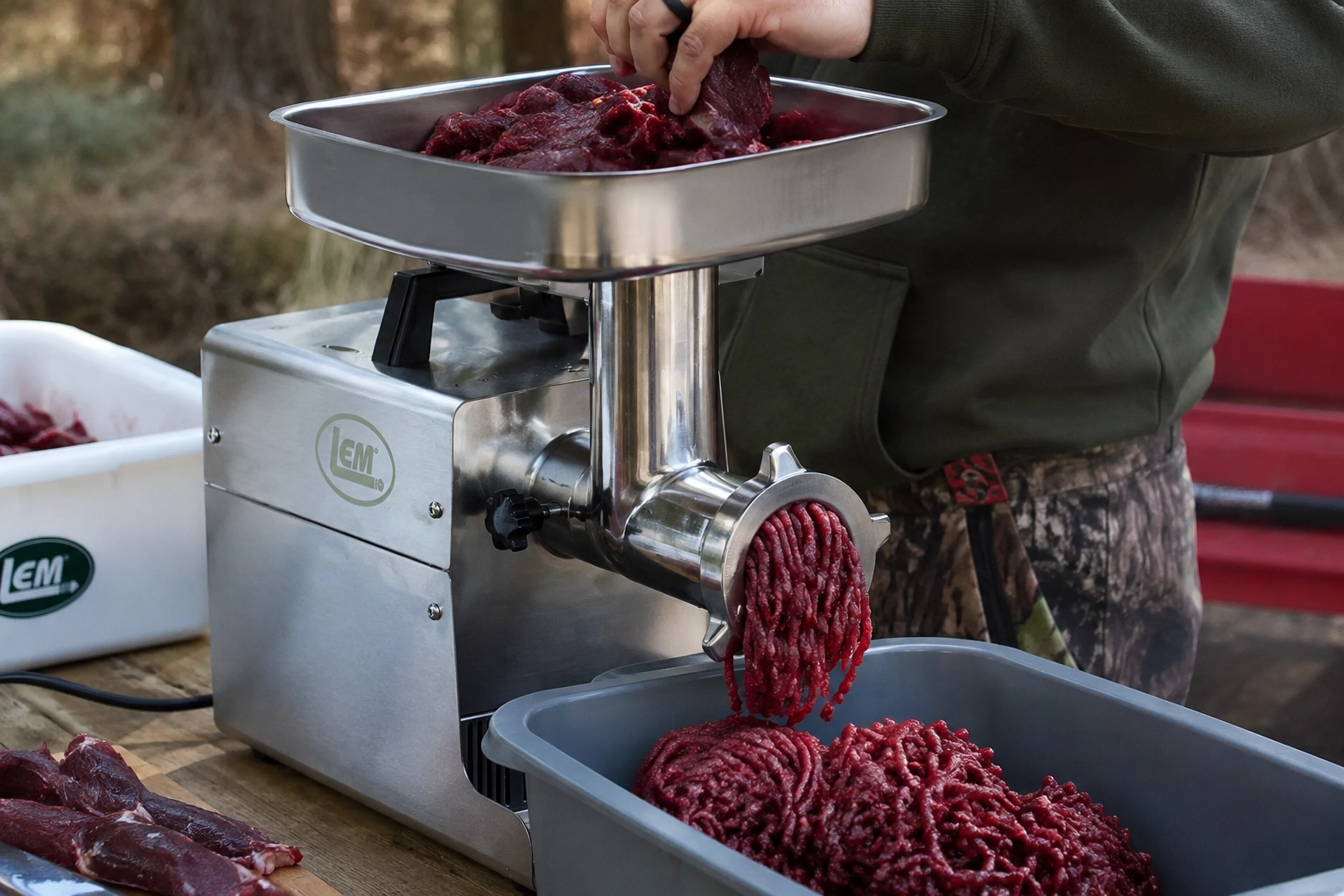
The first time I ground my own deer, I did it with a grinder built for a kitchen, not a whitetail. It was a stand-mixer attachment, and it choked on cold venison sinew about four pounds in, smeared more than it cut, and turned what should’ve been an hour of work into an afternoon of babying an overheating motor between short bursts. I didn’t know yet that “meat grinder” is a category with a huge gap between what handles a chicken breast and what handles a cold, sinewy hindquarter in a 20-degree garage.
That’s the gap most meat grinder roundups don’t address. Most of what ranks for “best meat grinder for deer” is written from a generalist wild-game angle, tested on warm beef in a kitchen, or leaning almost entirely on one manufacturer because that’s whoever sent the most review units. None of that tells you what you actually need to know: how a grinder handles cold trim after a long processing session, whether the throat clogs on connective tissue, and how much cleanup time you’re signing up for.
I’ve ground venison every fall for years now, on equipment ranging from underpowered to genuinely overkill, and I’ve watched enough of it happen at deer camp with other people’s grinders to know where the real failure points are. What follows is five grinders across the actual range of what a home processor needs, from a first-timer doing one deer a year to a camp running multiple hunters through a season’s worth of animals, with the honest tradeoffs included, not just the spec sheet.
The Short Answer: For most hunters doing one or two deer a year, the LEM Big Bite #8 Dual Grind is the pick that balances price, power, and durability. If you’re just testing whether home grinding is worth it, the STX International Turboforce gets you through a season without much investment. Processing three or more deer, or running serious sausage volume, step up to the Weston Pro Series #12. Multiple hunters or a full camp’s worth of animals calls for the LEM Big Bite #22. And if you already own a stand mixer and process light volume, the KitchenAid grinder attachment saves you from buying a standalone unit at all.
Why Grinder Selection Actually Matters for Deer Processing
Whitetail is lean. Once the backstraps, tenderloins, and the cleanest roasts are off the bone, most of what’s left, shoulders, neck meat, rib trim, smaller sinewy sections, is grind material. That’s not a downside, it’s just the reality of the animal, and it means your grinder isn’t a specialty tool for sausage hobbyists. It’s the piece of equipment that determines what happens to most of your deer.
Grinder size numbers (#5, #8, #12, #22, and up) refer to the diameter of the grinder head and throat, not some abstract quality tier. A bigger number means a wider throat that swallows larger chunks of meat without as much pre-cutting, a bigger plate with more holes moving more meat per revolution, and generally a bigger motor behind it. For a home processor doing one or two deer a year, a #8 is the honest sweet spot. Step up to a #12 if you’re doing three-plus deer or heavy sausage volume, and a #22 only makes sense if you’re processing for a camp, or mixing in elk or moose.
Food safety is the part most gear roundups skip entirely, and it matters here more than people think. According to the USDA’s Food Safety and Inspection Service, grinding meat exposes more surface area to any bacteria present and mixes it throughout the batch, rather than leaving it on the surface where cooking kills it more reliably. That’s true of beef and it’s true of venison. Keep your trim cold right up until it hits the grinder, Penn State Extension’s wild game processing guide recommends keeping meat below 40°F during grinding and mixing, and don’t let ground venison sit at room temperature.
There’s a second layer specific to deer country, and specifically relevant if you’re processing more than one animal on the same equipment. The University of Minnesota’s CWD Watch program notes that a one-to-one bleach-and-water solution with five minutes of contact time is effective at breaking down CWD prions on stainless steel tools and surfaces. I run my grinder parts through that same routine between deer now, not because I’ve had a positive test, but because it’s a five-minute habit against a real, if uncommon, risk.
The last thing worth knowing before you buy: grinder wattage claims are often peak or surge numbers, not what the motor actually pulls under sustained load grinding cold, sinewy venison. A “3000W” grinder that draws a fraction of that continuously isn’t lying exactly, but it’s not telling you the number that matters either. I’ve flagged where that’s relevant below.
Best Overall: LEM Big Bite #8 Dual Grind
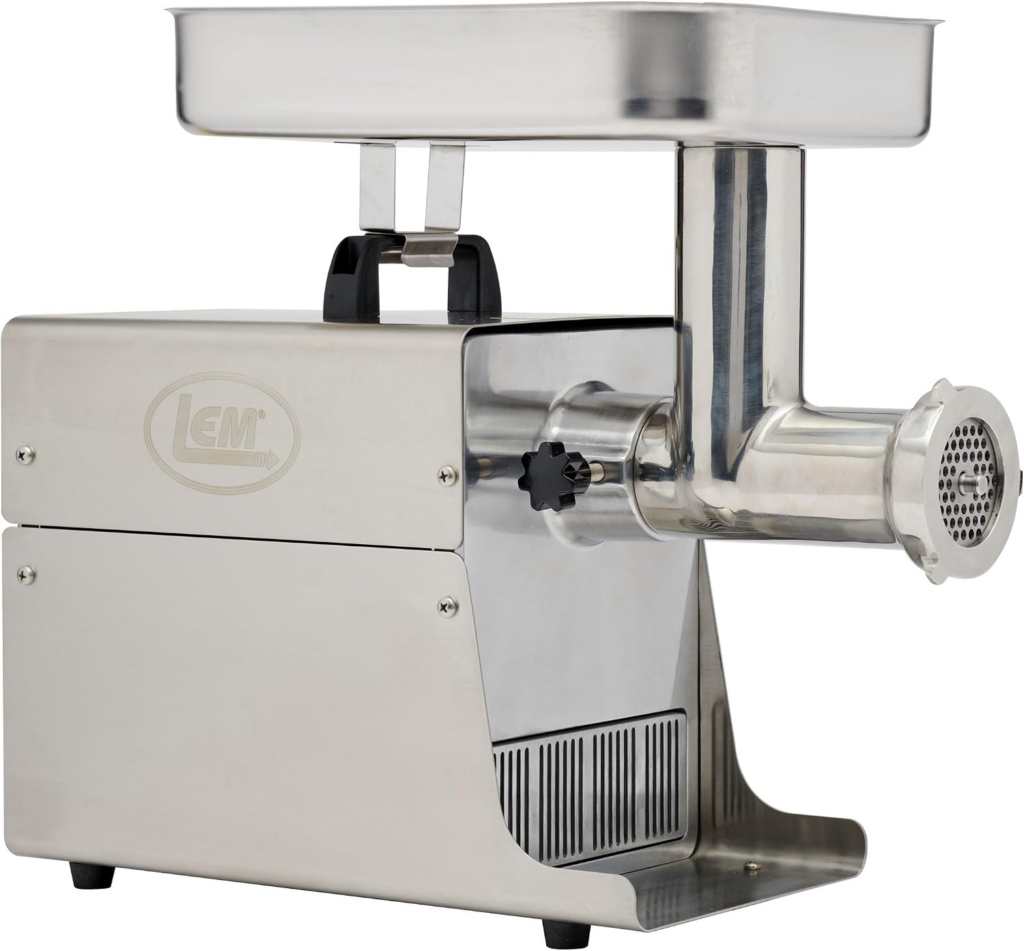
The LEM Big Bite #8 Dual Grind is the grinder I’d point most home processors toward without much hesitation, and it’s not close. This is the size and the brand that shows up in deer camps across the Midwest for a reason, and the review depth backs it up, this exact model carries nearly 500 reviews at Scheels alone, which is a genuinely different level of real-world track record than most of what’s on this list.
What works: The Dual Grind system runs meat through a coarse and fine plate in a single pass using a double-edged knife, which means a premium two-stage grind without manually running everything through twice. That’s a real time saver on a full deer’s worth of trim, not a marketing gimmick. The 0.5 HP motor and BigBite auger technology grab larger chunks of meat and move them through the head faster than a standard auger, which translates to fewer jams on cold trim with connective tissue still attached, the exact failure point that ruins a processing afternoon. The whole head, auger, and meat pan are stainless steel, and LEM backs it with a 5-year warranty.
Midwest-specific performance: This is the size built for exactly what most SE Minnesota hunters are doing: one to two deer a season, not a commercial operation. The stainless construction shrugs off a cold, damp garage far better than aluminum, and the dual-grind head means you’re not standing at the machine for an extra 20 minutes doing a second pass on a night when your hands are already numb.
The compromise: At this price, you’re paying for durability and speed, not portability, this is a machine that lives on a bench, not something you’re packing to camp. It’s also more grinder than a single-deer-a-year hunter strictly needs, though the extra headroom means it’ll still be doing the job a decade from now instead of getting outgrown in year two.
Best for: Hunters processing one to two deer a season who want a grinder that isn’t the weak link in their setup, and won’t need replacing as their processing volume grows.
Price: $569.99
➡️ Check Price on Amazon — $569.99 | Check Price at Scheels — $569.99
Budget Pick: STX International Turboforce
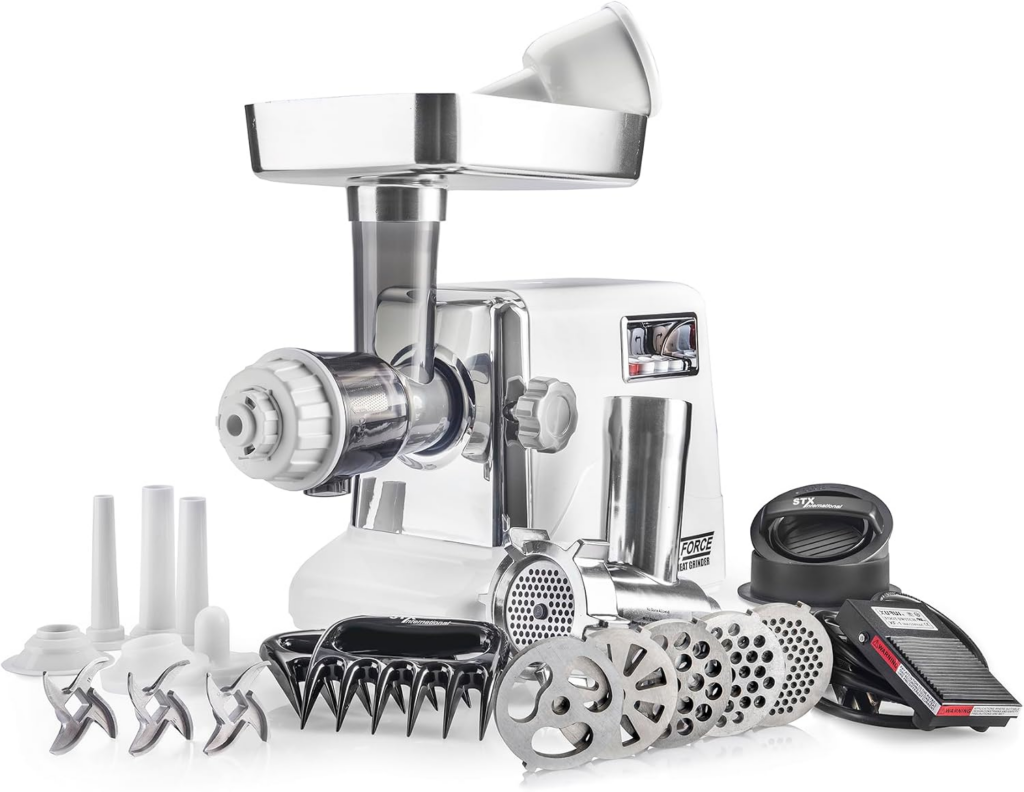
Not everyone wants to spend several hundred dollars before they know whether home grinding is even worth the time. The STX International Turboforce is the set I’d point a genuinely budget-conscious first-timer toward, and it’s a real second manufacturer in this lineup, not just a cheaper LEM.
What works: The Turboforce loads you up on accessories for the price, multiple grinding plates, stainless blades, sausage stuffing tubes, a kubbe maker, and on some versions a foot pedal for hands-free operation. Three-speed control gives you more flexibility than a single-speed budget unit, useful for switching between a coarse first pass and a finer second grind without changing plates mid-job.
Midwest-specific performance: For a hunter doing one deer a year who wants to try home grinding without a big upfront commitment, this covers the job. It’s a legitimate way to find out whether you actually want to keep doing this yourself before spending LEM or Weston money.
The compromise: Be honest with the wattage claims here. Marketing numbers in this segment (“3000W,” “4000W”) are typically peak or surge draw, not sustained output, the real continuous power is meaningfully lower, and that shows up as a machine that’s more prone to jamming or bogging down on tougher connective tissue than the stainless LEM and Weston picks above it. It’s also a lighter-duty build overall, don’t expect this to be the grinder you’re still running in ten years.
Best for: First-time home processors testing the waters, or anyone doing a single deer a year who doesn’t want to commit real money until they know they’ll keep doing it.
Price: $199.80
➡️ Check Price on Amazon — $199.80
Step-Up Pick: Weston Pro Series #12
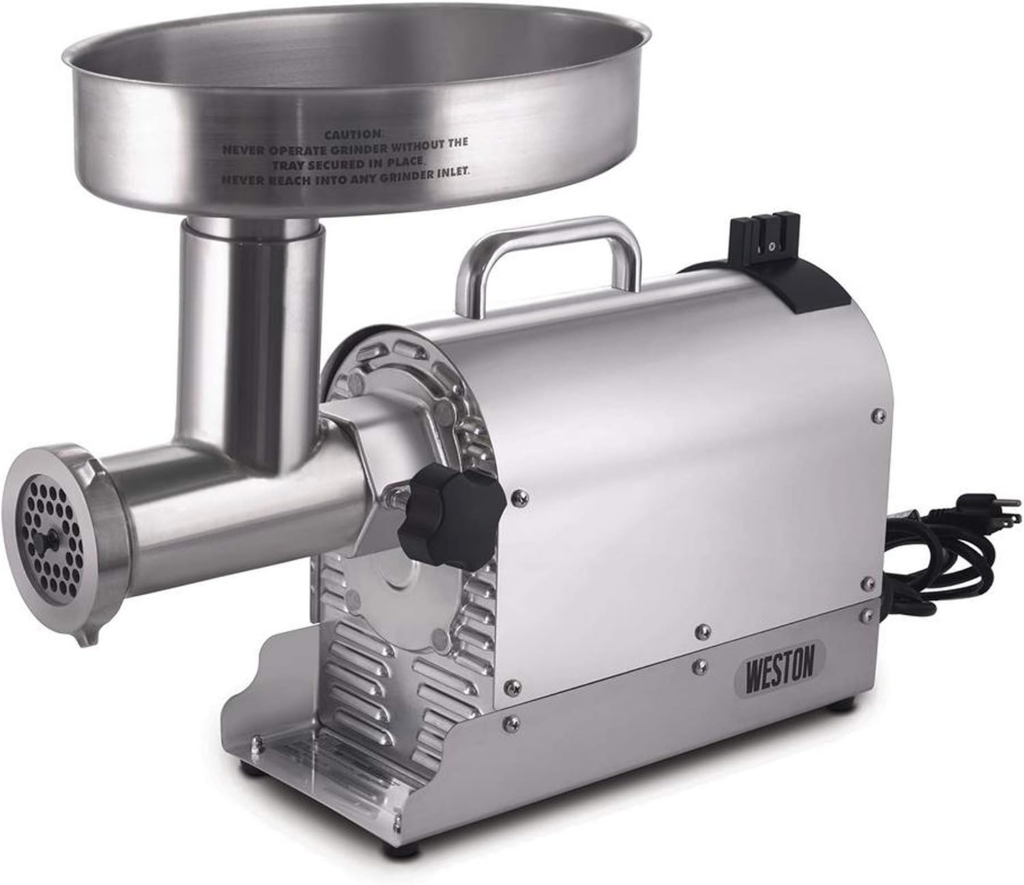
Once you’re consistently processing three or more deer a season, or you’re making serious volumes of sausage, the Weston Pro Series #12 is the honest step up from a #8. Weston is a real second brand here, not a repackaged version of anything else on this list, and it’s the grinder a lot of serious home processors land on once they’ve outgrown an entry unit.
What works: The 1 HP, 750-watt air-cooled motor is built to run continuously through bulk loads rather than short bursts, and it grinds 6 to 9 pounds per minute, genuinely faster than the #8 tier. The rifled head design and offset throat are engineered specifically for speed, and the included sausage stuffer kit comes with four funnel sizes, from snack sticks up to kielbasa-scale links, which matters if sausage-making is actually part of your plan rather than an afterthought. The built-in knife sharpener is a small but genuinely useful touch during prep.
Midwest-specific performance: The bigger throat and higher throughput mean less standing-around time on a night when you’re processing multiple deer back to back, which is exactly the scenario a camp or a family doing several animals a season runs into every November.
The compromise: This is a bigger, heavier unit built for volume, and it’s overkill if you’re doing one deer a year, you’re paying for throughput you won’t use. The larger meat pan and motor housing also take up more bench and storage space than the #8-class grinders.
Best for: Hunters processing three-plus deer a season, or anyone whose sausage-making is a real priority rather than an occasional project.
Price: $743.45
➡️ Check Price on Amazon — $743.45
Camp / Heavy Duty Pick: LEM Big Bite #22 Dual Grind
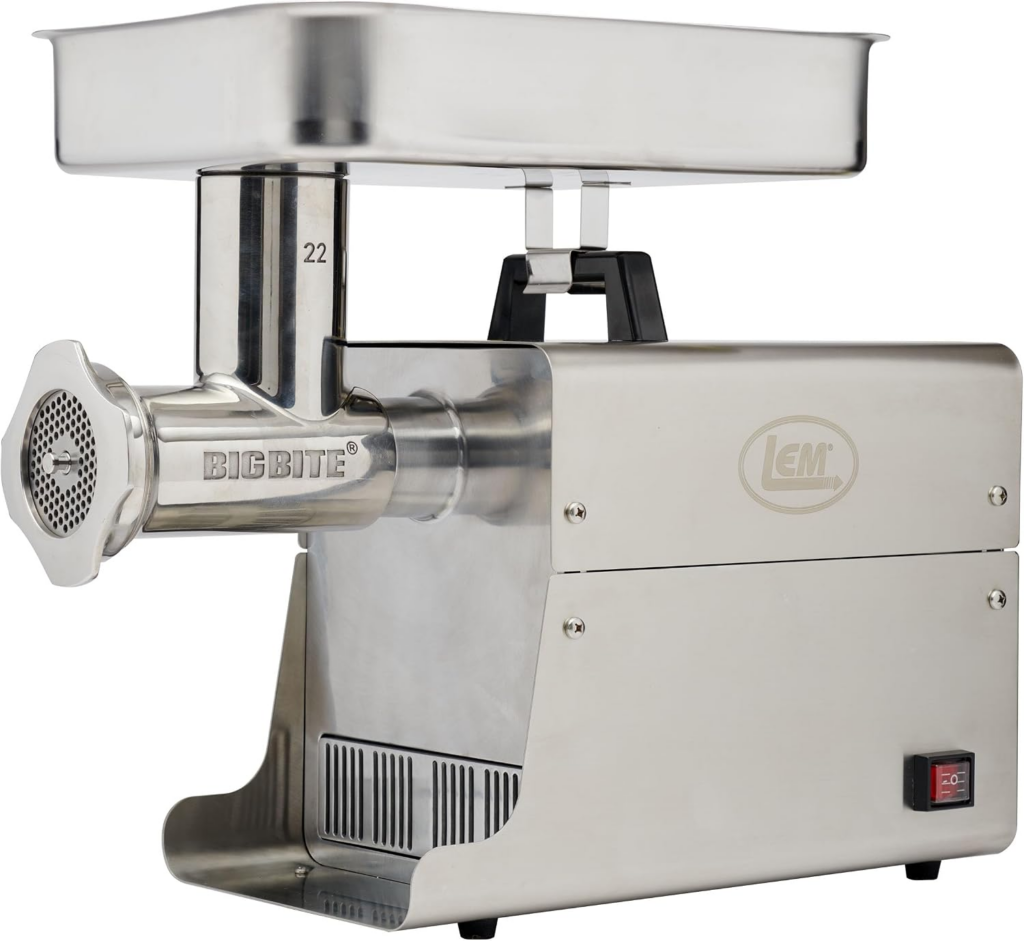
For a deer camp running multiple hunters through a season’s worth of animals, or anyone mixing elk or moose into the mix, the LEM Big Bite #22 Dual Grind is the size that actually keeps up.
What works: Same Dual Grind, single-pass, coarse-then-fine system as the #8, scaled up to a much larger head and throat, LEM’s #22 line grinds in the neighborhood of 13 to 18 pounds per minute depending on the meat. That’s an entirely different category of throughput, the difference between grinding one deer’s trim and grinding four deer’s trim in the same afternoon without the machine becoming the bottleneck. Stainless construction throughout, same 5-year warranty backing it.
Midwest-specific performance: This is the grinder that actually makes sense for a camp splitting equipment costs across several hunters, which is a real pattern in Driftless Area deer camps, one good #22 outperforms three separate #8s and costs less than buying three. It also has the headroom to handle elk or moose trim without straining, which a #8 genuinely cannot.
The compromise: This is a serious investment and a serious footprint, it’s heavy, it takes up real bench space, and it’s flatly more grinder than a one-or-two-deer hunter needs. Buying this size for a single animal a year is buying capacity you’ll rarely use.
Best for: Multi-hunter camps, anyone processing three-plus deer plus other big game, or serious sausage operations running high volume.
Price: $729.99
➡️ Check Price on Amazon — $729.99 | Check Price at Scheels — $729.99
Value Pick: KitchenAid Grinder Attachment
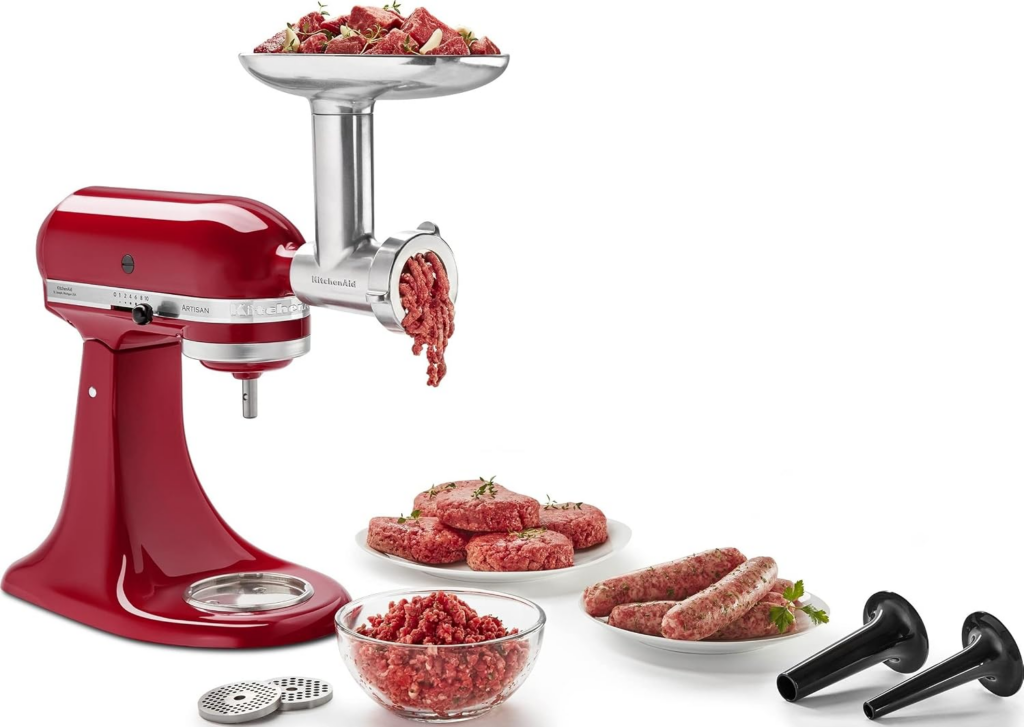
If you already own a KitchenAid stand mixer and process light volume, you might not need a standalone grinder at all. The KitchenAid grinder attachment is worth mentioning specifically because nobody else covering this topic addresses the reader who’s already got the base appliance sitting on their counter.
What works: It’s inexpensive relative to every other pick here, stores in a fraction of the space of a standalone unit, and does a genuinely fine job on a small batch of already-trimmed, well-chilled venison. If your total grind volume from a single deer is modest and you’re not in a hurry, it gets the job done.
Midwest-specific performance: For a hunter who processes light and isn’t trying to run through a full deer’s worth of trim in one sitting, this avoids buying and storing a dedicated appliance you’d use six weeks a year.
The compromise: Your stand mixer’s motor was built for dough and batter, not cold, sinewy venison, and it shows. Expect a slower grind, more frequent clogs on tougher trim, and real risk of straining or overheating the mixer’s motor if you push more than a modest batch through it in one session. This is not the choice for anyone processing more than a single deer’s trim, or anyone who wants speed over patience.
Best for: Light-volume processors who already own a stand mixer and don’t want a standalone grinder taking up space for a job they do once a year.
Price: $122.64
➡️ Check Price on Amazon — $122.64
Comparison Table
| Grinder | Size | Approx. Grind Rate | Best For | Price |
|---|---|---|---|---|
| STX International Turboforce | Compact | Varies, 3-speed | First-timers, single deer/year | $199.80 |
| LEM Big Bite #8 Dual Grind | #8 | ~4.5–7 lbs/min | Best overall, 1–2 deer/year | $569.99 |
| Weston Pro Series #12 | #12 | 6–9 lbs/min | 3+ deer/year, sausage volume | $743.45 |
| LEM Big Bite #22 Dual Grind | #22 | ~13–18 lbs/min | Camps, multi-deer, elk/moose | $729.99 |
| KitchenAid Attachment | N/A | Slow, small batch | Already own a mixer, light volume | $122.64 |
How to Choose the Right Grinder for Your Volume
Match the Grinder to How Much You Actually Process
The single biggest mistake home processors make is buying based on what sounds impressive rather than what matches their actual volume. One deer a year doesn’t need a #22, and three-plus deer a year will make a #8 feel like a bottleneck by the third animal. Be honest about your real annual volume before you buy, not your aspirational volume.
Cold Meat Is Non-Negotiable
Every grinder on this list performs better on cold meat, and every one of them jams more easily on trim that’s been sitting out warming up. Keep meat and grinder parts in the freezer for 30 to 45 minutes before you start, this isn’t a nice-to-have tip, it’s the single biggest factor in whether your grinding session goes smoothly or turns into an hour of fighting clogs.
Don’t Skip the Fat Ratio Decision
Whitetail is lean enough that straight ground venison often comes out dry once cooked past medium. Penn State Extension’s guidance and most experienced processors land in a similar range, roughly one part pork or beef fat to three or four parts venison for burger, adjusted up toward equal parts for sausage. Grind your fat first, then blend it in, rather than trying to mix cubes of fat and venison together before a single pass.
Cleanup Time Is Part of the Real Cost
A grinder that’s fast to disassemble and dishwasher-safe (or close to it) saves real time on a night when you’re already tired from a full processing session. All-metal construction on the LEM and Weston picks means a more thorough cleaning routine than the mostly-plastic KitchenAid attachment, but it’s also more durable and easier to keep sanitary over years of use.
Keeping Your Grinder Running and Clean
Rinse and dry every component that touched meat immediately after use, don’t let trim sit in the head or auger overnight, that’s how odor and bacteria build up in the crevices a quick rinse won’t reach. A soft brush gets into the plate holes and auger threads better than a sponge. Dry everything completely before reassembly or storage, stainless steel can still develop surface rust if it’s put away wet.
Between deer, especially if you’re processing more than one animal or sharing equipment across a camp, run metal components through a one-to-one bleach-and-water solution with five minutes of contact time, per the University of Minnesota CWD Watch guidance referenced above. It’s a five-minute habit, not a hassle, and it’s the same logic that applies to knives during butchering.
Store the head, plates, and auger somewhere dry rather than sealed up damp in a case, and a light coat of food-safe mineral oil on metal components before off-season storage prevents surface rust from creeping in over the months your grinder sits idle.
Bottom Line: Best Meat Grinder for Most Home Processors
For most hunters processing their own deer, three of these five cover the realistic range of needs.
Best Overall: LEM Big Bite #8 Dual Grind. This is the grinder to buy if you’re processing one to two deer a season and want a machine that won’t be the weak link in your setup. It’s not the cheapest option here, but the review track record, the dual-grind speed, and the 5-year warranty make it the easiest overall recommendation.
Best Budget: STX International Turboforce. If you’re not sure home grinding is for you yet, or you’re processing one deer a year on a tight budget, this gets you through a season and lets you find out before you spend LEM or Weston money.
Best for Volume: Weston Pro Series #12 or LEM Big Bite #22. Once you’re consistently doing three-plus deer, or you’re grinding for a whole camp, step up. The #12 handles serious volume for an individual processor; the #22 is the right call if you’re splitting equipment across multiple hunters or mixing in elk.
The worst move is buying based on the biggest number instead of your actual volume, or trying to make a stand mixer attachment do a standalone grinder’s job on more than a single deer’s worth of trim. Match the machine to what you’re actually processing, not what sounds impressive on the shelf.
Looking for More
This guide covers the grinder itself, but a full home processing setup involves more than one tool. Check out our full hub guide, How to Butcher a Deer at Home (Without Screwing It Up), which walks through the entire process from skinning to freezer, including CWD and lymph-node guidance specific to Driftless Area hunters. If your knife setup needs an upgrade before your grinder does, our guide to the Best Butcher Knife Sets for Home Deer Processing covers that first stage of the job.
We’re also building out guides to the rest of a home processing setup, including the best vacuum sealers, dehydrators, and chest freezers for venison, which will link here once published.
FAQs
A #8 is the honest answer for most one-or-two-deer-a-year hunters. It’s fast enough that you’re not standing at the machine for hours, and it’s not so much grinder that you’re paying for throughput you’ll never use. Sizing up to a #12 or #22 only pays off once your actual volume, not your aspirational volume, justifies it.
For a single deer’s worth of already-trimmed, well-chilled meat, yes, it’ll get the job done. It’s slower, more prone to clogging on tougher trim, and puts real strain on a motor built for dough rather than sinew, so it’s not the right call for anyone processing more than one animal or trying to move through a full deer quickly.
Not always, but most people do for burger and sausage. Whitetail is lean enough that straight ground venison can come out dry, especially cooked past medium. A common range is roughly one part pork or beef fat to three or four parts venison for burger, with sausage typically running closer to equal parts. Grind the fat first, then blend it into the venison rather than mixing cubes of both together before a single pass.
Check the blade for visible dullness or nicks before each processing session, a dull blade doesn’t cut clean, it tears and smears, which shows up as a mushy texture in the finished grind. Most home processors get several seasons out of a blade with occasional sharpening before replacement makes more sense than resharpening.
That’s a personal risk decision, not one your grinder or this article makes for you. What is squarely a grinder question is equipment hygiene: if you’re processing multiple deer, including ones with unconfirmed status, running metal components through a one-to-one bleach-and-water solution with five minutes of contact time between animals is a reasonable precaution regardless of your final consumption decision.
Some of that is simply venison’s flavor profile, which is naturally different from beef regardless of processing quality. But a meaningful amount of what people blame on “gamey” flavor actually traces back to poor trimming, silverskin and fat left on trim before grinding doesn’t fully break down in the grinder, and it’s a common source of off texture and flavor that gets blamed on the animal instead of the prep work.
It’s a convenience feature, not a necessity. A foot pedal keeps your hands free to feed meat continuously without stopping to hit a switch, which speeds up a long session, but every grinder on this list works fine without one. If you’re processing high volume regularly, it’s worth having; for one deer a year, it’s not a deciding factor.
