

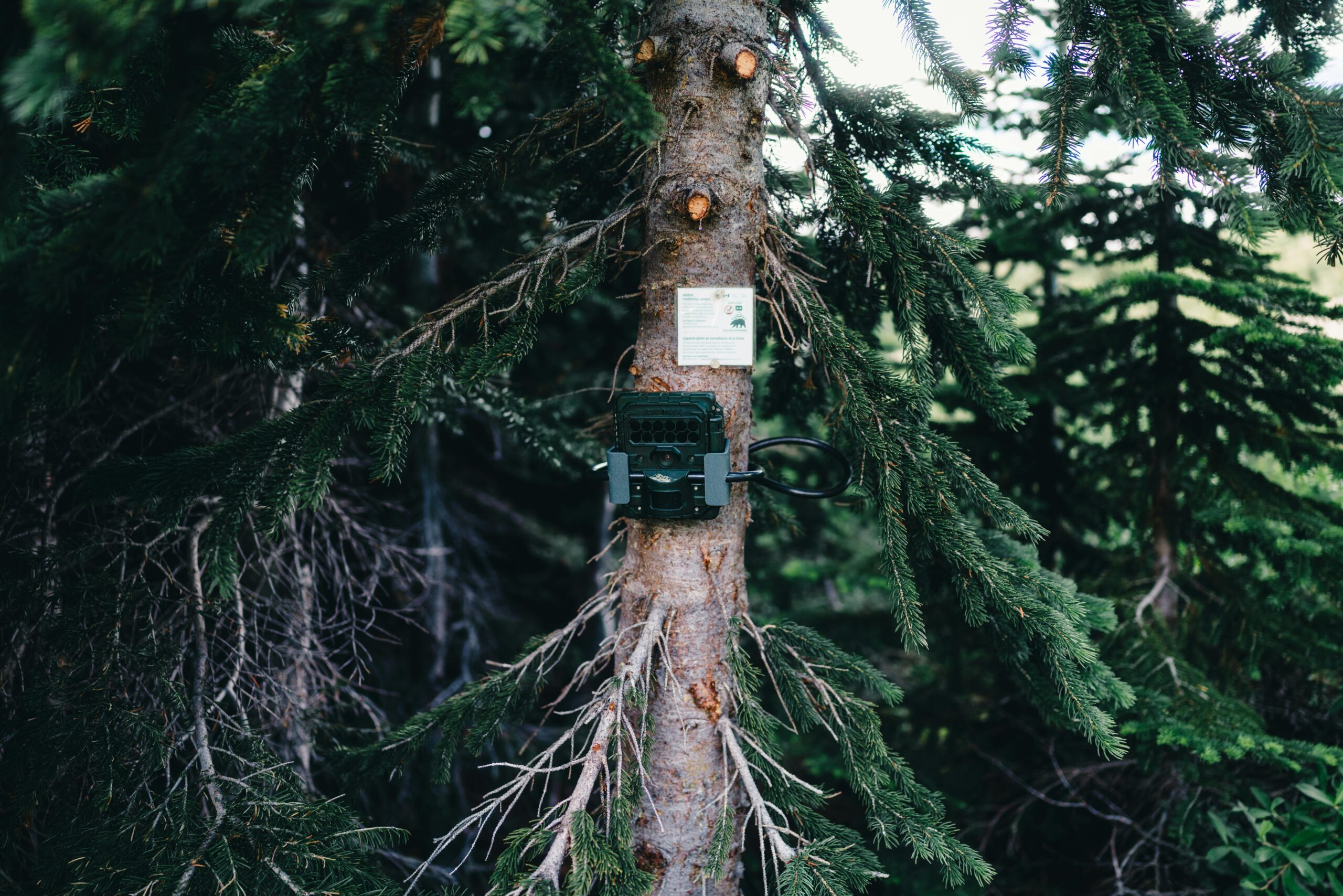
I got a notification at 2:14 a.m. on a Tuesday in mid-October. A buck I’d been watching since July was standing at a scrape 200 yards from my best stand in southeastern Minnesota. I knew his entry route, I knew the wind I needed, and I knew exactly when to be in the tree the next evening. That’s what a good cellular trail camera does, it hands you information you couldn’t get any other way, without ever burning a trip into the woods.
Getting there took some wrong turns first. I’ve run cameras that died in a December cold snap because I loaded them with alkalines instead of lithiums, a mistake that costs Midwest hunters more cameras than any hardware failure. I bought an AT&T-only camera for a property in Aitkin County, Minnesota, where AT&T has no meaningful rural coverage. I put a red-glow camera on a public land scrape one September and watched a mature buck use that trail exactly once before he pattern-shifted away from the location for the rest of the season. These aren’t edge cases. They’re the specific ways Midwest hunters waste money on cameras every year.
What separates this guide from generic trail camera lists is the Midwest-specific detail: which cameras run on Verizon vs. AT&T and why that matters by state, how alkaline batteries behave at -10°F vs. lithiums, and why no-glow flash matters more on pressured public land in northern Wisconsin than it does on a private farm in Iowa. The cameras here range from $83 to $400, span cellular and non-cellular, and cover every realistic hunting situation across MN, WI, and IA. The right one depends on where you hunt, how you hunt it, and how much you want to spend. The table below gets you there fast.
What Makes Trail Cameras Essential for Midwest Whitetail Scouting
Whitetail deer hunting in Minnesota, Wisconsin, and Iowa is a data-gathering game as much as it is a hunting game. You’re not just trying to fill a tag, you’re trying to identify individual bucks, pattern their movement, figure out when they shift from summer range to fall range, and time your sits accordingly. Trail cameras are how you do that without burning scent and bumping deer off a property. Research from the Quality Deer Management Association shows that hunters who use systematic camera surveys to inventory bucks make more informed harvest decisions and see measurable improvements in herd age structure over time. That’s not marketing copy, it’s documented data from decades of deer management work.
The cellular trail camera has changed everything about in-season scouting. Before cellular cameras, you had to physically check your SD card, which meant walking into your hunting area, leaving scent, bumping deer, and tipping off every mature buck in the county that something was wrong. Now you get a notification on your phone at 2 a.m. that a shooter is working a scrape. You pull the card once a month instead of every week. That alone is worth every dollar you spend on a subscription plan.
The difference between a $50 camera and a $150 camera shows up in trigger speed, flash quality, and cellular reliability. TrailCamPro, which has been independently testing trail cameras since 2003, consistently shows that the gap between a 0.08-second trigger and a 0.7-second trigger is the difference between a full-frame buck photo and a blurry tail shot. For identification purposes, especially on mature deer that move at a trot through a scrape line, trigger speed matters more than megapixels. A 30MP photo of a buck’s hindquarters tells you nothing useful.
Midwest conditions add specific demands that national gear guides ignore. Alkaline batteries, the cheap ones people buy by the 48-pack at Costco fail fast below 20°F. At -10°F, which Minnesota and northern Wisconsin see regularly from December through February, alkalines can die in two to four weeks. Energizer Ultimate Lithium batteries maintain performance down to -40°F and are what I run in every camera that stays out past October. If you’re buying budget cameras and loading them with dollar-store batteries, you’re throwing money away.
The 7 Best Trail Cameras for Midwest Deer Hunting
1. Tactacam Reveal Ultra — Best Overall Cellular
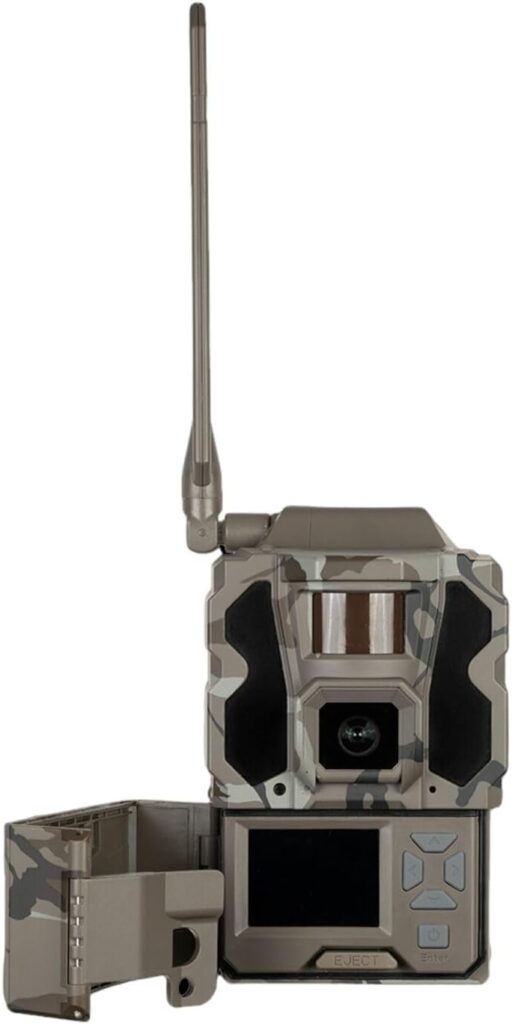
The Tactacam Reveal Ultra is the camera I’d buy if somebody handed me $300 and said get one cellular cam to cover 90% of what a Midwest whitetail hunter needs. Field & Stream named it Best Overall Cellular Trail Camera of 2025.
What works: The 0.26-second trigger is among the fastest on the market. Multicarrier LTE auto-select between AT&T and Verizon kept the Reveal Ultra connected on a farm where my old Verizon-only camera died in a dead spot. The 2-inch LCD inside the door lets you aim without pairing to your phone, small feature, huge in the cold. Flash is toggleable: 96-foot low-glow or 80-foot no-glow.
Midwest-specific performance: Active GPS pings your phone if somebody moves it more than half a mile, a real concern on leased or public ground. Battery runs 7.4 months in picture mode on Tactacam’s lithium cartridges, through a full November cold snap without issue. Live view streaming lets you peek at the scrape before the walk-in.
The compromise: Plan fees add up, budget $10-15 per camera per month. Video mode drops battery life hard (3.3 months).
Best for: Serious hunters with 40+ acres who want one premium camera doing everything.
Amazon: $289.99 | Scheels: $419
2. Moultrie Edge 3 — Best Budget Cellular
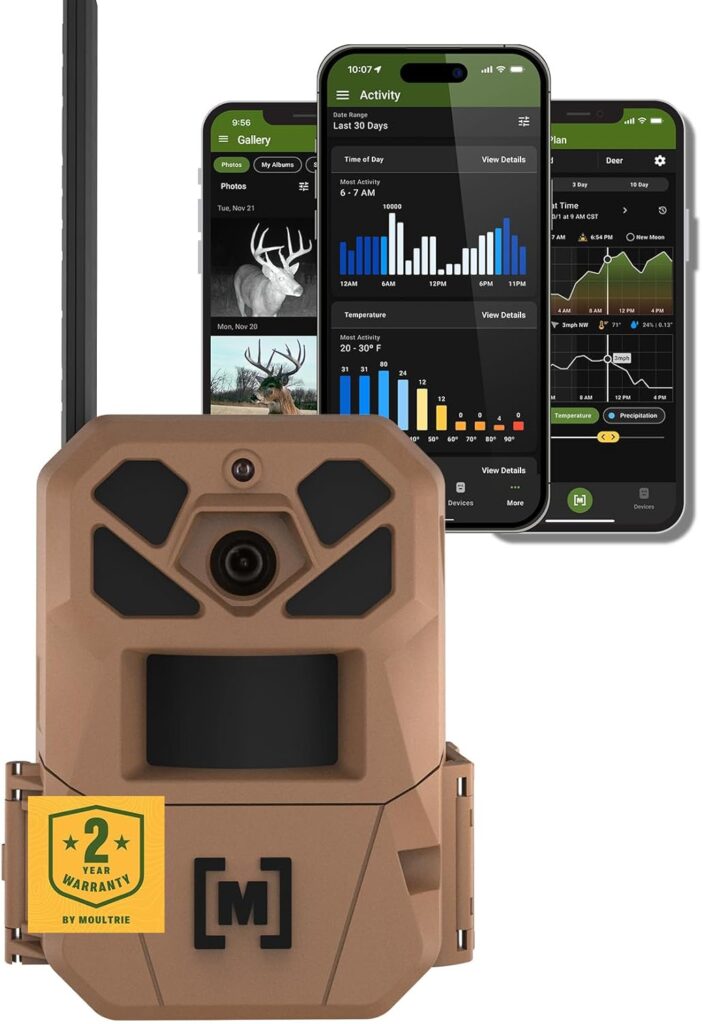
The Moultrie Edge 3 at $83 is the best value in cellular right now. I’d hand it to a buddy getting into cellular for the first time without a second thought.
What works: 40-megapixel photos, 1080p video, 100-foot low-glow detection, and a 0.5-second trigger. Multi-carrier coverage auto-selects between networks, the feature that makes the Edge 3 punch above its weight in rural MN and WI. Moultrie AI filters false triggers so you’re not scrolling through 200 photos of a waving branch. Built-in 16GB memory means no SD card to lose.
Midwest-specific performance: On a late-summer cornfield deployment in southern Minnesota, the Edge 3 delivered pictures reliably on a weak 1-bar signal auto-carrier switched to AT&T when Verizon dropped. Live Aim sets up with real-time framing, which matters when you’re hanging cameras on public ground and want to spend as little time on-site as possible.
The compromise: Battery life on AA alkalines is shorter than the Ultra plan on 3-4 months, or spring for Moultrie’s Power Mag lithium pack. The 0.5-second trigger is slower than the Tactacam so you’ll miss a few close-range fast movers. Cell plans start at $9.99/month.
Best for: First-time cellular users, hunters buying multiples across a property.
Amazon: $83 | Scheels: $99.99
3. Browning Defender Vision Pro LiveStream — Best Live Streaming
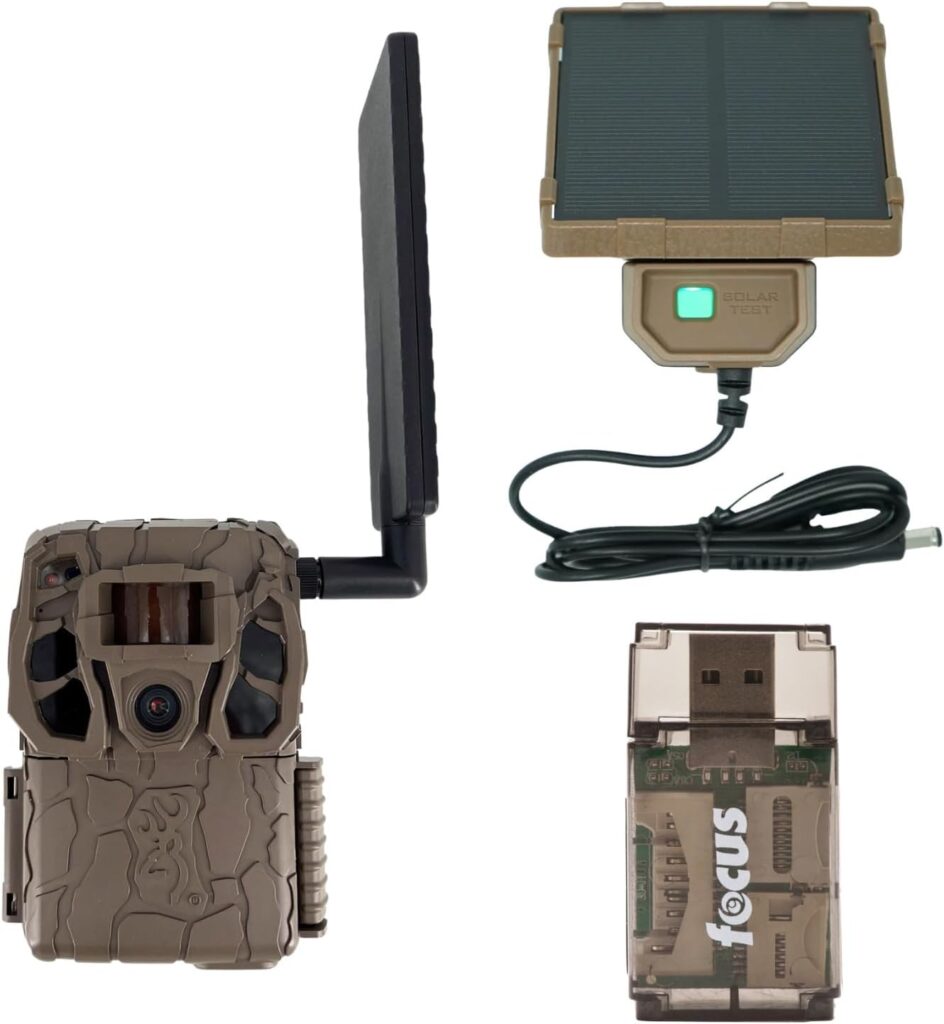
The Browning Defender Vision Pro LiveStream is the only camera in this guide that does genuine real-time video streaming. Not on-demand clips you wait on tap the app and watch your scrape as it happens.
What works: 46-megapixel photos, 1080p HD video with sound, and 110 feet of no-glow IR flash. Browning’s 2025 rebuild solved the build-quality problems that hurt earlier cell cams tight single-latch door, blade-style dual-carrier antenna, and an aluminum tree bracket with teeth that keeps the Defender from rocking in wind. AI recognition filters raccoons and squirrels.
Midwest-specific performance: Live streaming changes how you hunt the rut. I ran the Vision Pro on a funnel last fall and used the stream twice to confirm a buck was still bedded before I climbed real-time, not 20-minute-delayed. For observation stands, it’s a genuine edge.
The compromise: Streaming burns cellular data fast, use it selectively or blow through a plan in a week. Battery life of 4.1 months is respectable but not class-leading. Earlier Defenders had water-seepage problems that killed cameras; the 2025 Vision Pro housing appears fixed, but that reputation will take a season or two to shake.
Best for: Hunters confirming activity before a sit, properties with solid cell signal.
Amazon: $229.99
4. Bushnell Core S-4K No-Glow — Best Non-Cellular for Pressured Bucks
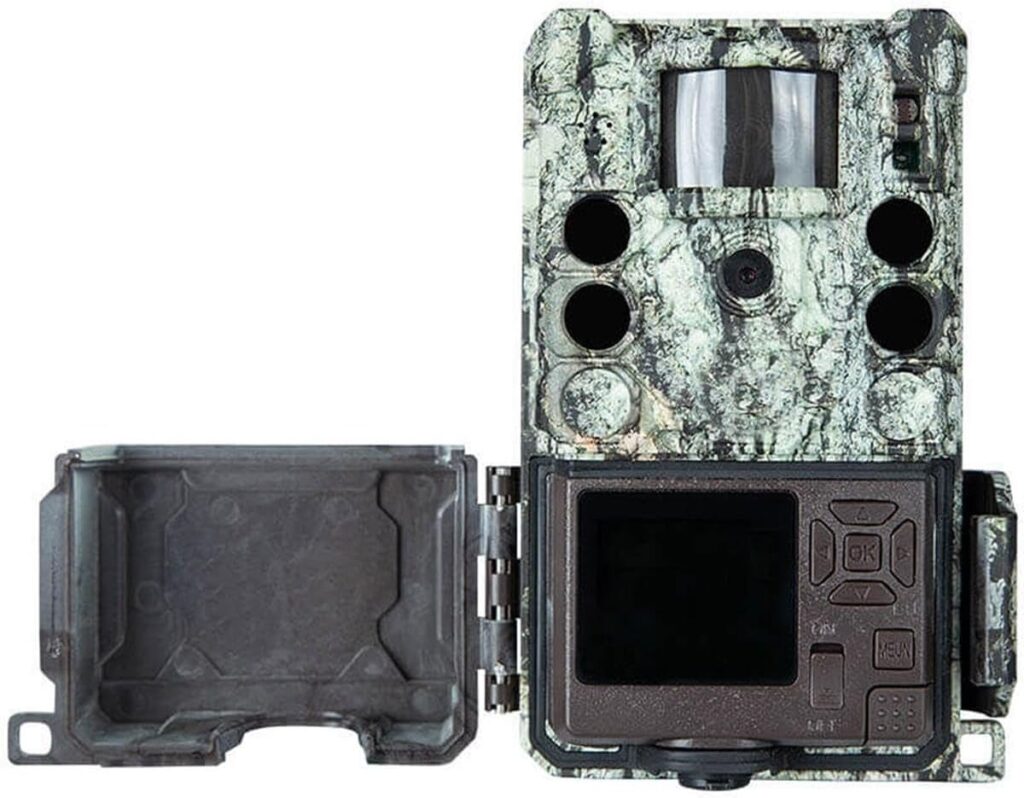
The Bushnell Core S-4K No-Glow is the pick for hunters who don’t want monthly fees or who hunt pressured ground where bucks pattern low-glow cameras.
What works: The 0.08-second trigger puts the S-4K in legitimate Reconyx territory at a fraction of the cost. Battery life runs 21 months in picture mode per Trailcampro’s testing genuinely set-and-forget. The 110-foot no-glow IR flash is invisible to deer and to poachers. The weather-sealed housing has run through a full MN winter for me including an ice storm and a polar vortex with zero water intrusion.
Midwest-specific performance: On public WMAs or heavily-pressured private ground, no-glow is the play. A low-glow camera putting out a faint red hint at 20 yards will eventually get noticed by an older buck. The S-4K stays dark. Six AA batteries (vs. 12 on a Reconyx) is meaningful when you’re buying lithium AAs at ten bucks a pack.
The compromise: Single-sensor design means daytime photos are noticeably less punchy than a dual-sensor rig (like Bushnell’s own pricier DS-4K). Detection tops out at 70 feet fine for tight trails, limiting on open food plots. And you’re still pulling SD cards, which means walking in and leaving scent.
Best for: Pressured public land, non-cellular backup setups, anyone skeptical of monthly plans.
Amazon: $129.79
5. Reconyx HyperFire 4K Ultra HD — Best Premium
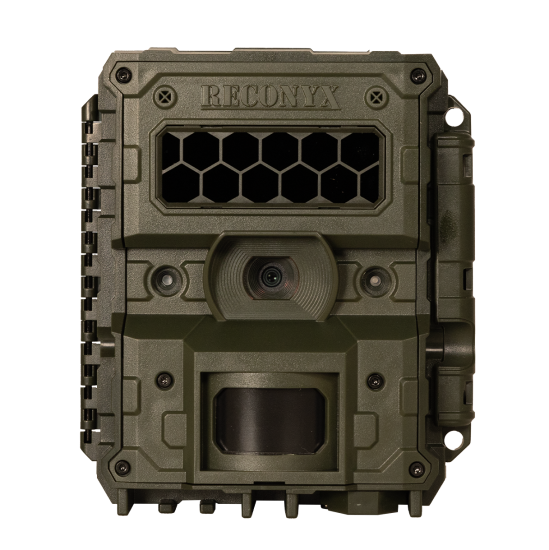
The Reconyx HyperFire 4K Ultra HD is what serious property managers and wildlife researchers run when they need a camera to survive a decade. Made in the USA, five-year warranty, and the only camera here with a true native 8-megapixel sensor no interpolation, no marketing math.
What works: 150-foot no-glow IR flash class-leading. Native 4K video. The most rugged housing in the industry. A 0.25-second trigger with 2.2-second recovery, and 110-foot detection. CodeLoc pass-code protection means a thief can’t use the camera even if they steal it. Runs on 12 AA lithiums or NiMH rechargeables alkalines will not work, which is a Reconyx-specific gotcha.
Midwest-specific performance: The HyperFire is for long-term private-land management where you set a camera once and know it’ll still be running eight seasons from now. The math pencils out for serious hunters: one $400 camera running reliably for a decade beats three $150 cameras replaced every other year.
The compromise: The menu interface is confusing, Trailcampro’s review flagged it specifically. Budget an hour with the manual. No cellular at this tier (Reconyx makes a separate cell line). And the price will make your wife squint.
Best for: Long-term private land managers, permanent camera setups on your best spots.
Scheels: $399.99
6. Moultrie Edge Solar — Best Solar Cellular
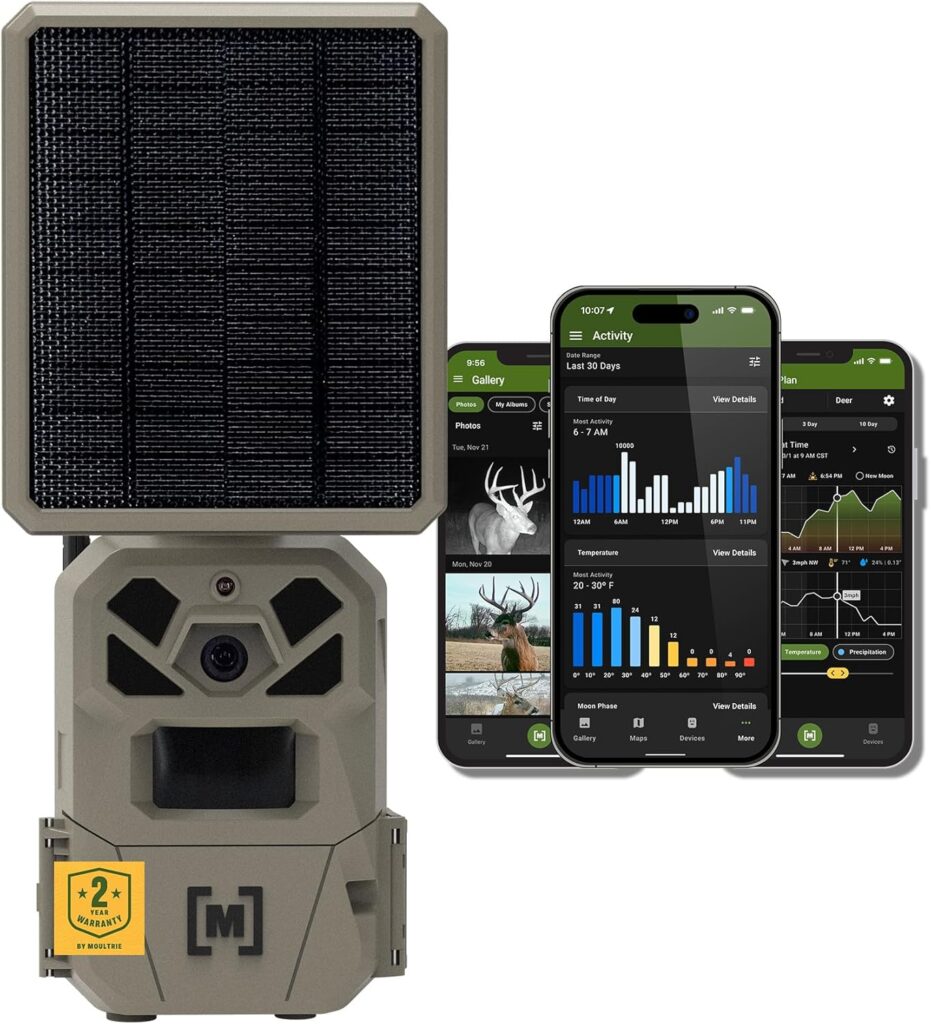
The Moultrie Edge Solar is the camera for the property you can’t check every weekend. Farm three hours away. In-laws’ land in Wisconsin. Public parcel you scouted in June and can’t babysit.
What works: The integrated solar panel is the largest on the market properly sized to keep the included rechargeable lithium battery topped up. The Edge Solar gets the same 40MP photos and 1080p video as the Edge 3, plus a 100-foot detection range and 0.4-second trigger. Multi-carrier coverage and adjustable panel angle let you optimize for south-facing sun after the leaves drop.
Midwest-specific performance: I set one on a CRP corner in June and did not touch it until October. Solar kept it running through summer when I’d normally be burning batteries or pulling cards. Moultrie’s app tells you if the panel’s getting sun or if a branch needs trimming before it becomes a problem.
The compromise: December through February in the upper Midwest is the catch short days, heavy cloud cover, snow on the panel. The reserve battery gets you through a rough week, but in a really gray stretch you’ll see it dip. If late season is your primary use case, plan on a mid-December battery top-up.
Best for: Remote properties, off-grid scouting, and hunters who hate changing batteries.
Amazon: $127.08
7. Stealth Cam Revolver 2.0 Pro — Best 360-Degree Coverage
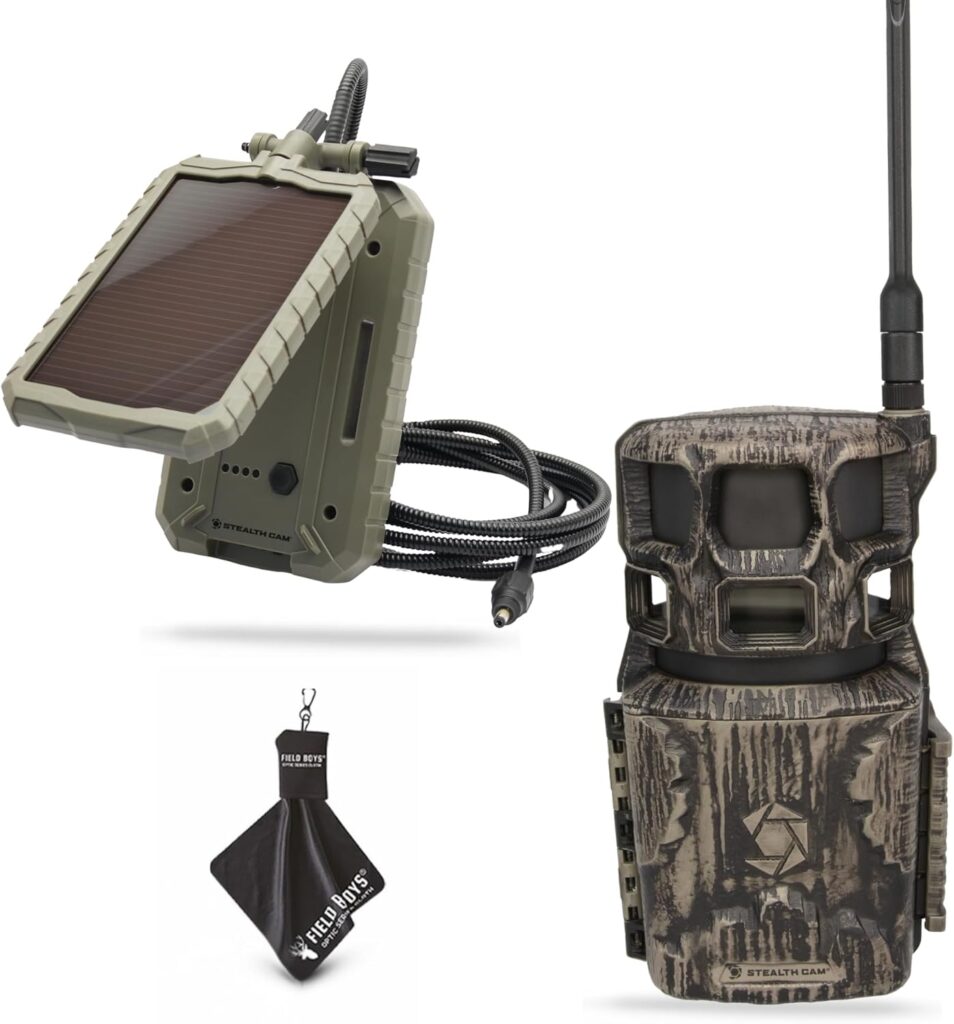
The Stealth Cam Revolver 2.0 Pro is the weirdest camera here and for open-country food plot setups, it’s a game-changer. Six PIR sensors cover 360 degrees, and a silent motor pivots the lens toward whichever zone triggered.
What works: 40MP photos (selectable down to 4MP to save data), 1440p QHD video with audio. Dual-core processing sends single-zone, 180-degree, and 360-degree captures simultaneously. The Revolver Pro gets a 0.22-second trigger and 110-foot detection class-leading numbers. Battery life runs 15.4 months in picture mode on 16 AAs. Built-in 32GB memory, no SD card.
Midwest-specific performance: On a square-acre alfalfa plot where deer enter from any edge, a traditional camera catches them on one side while a buck slips out the other. The Revolver watches all sides. I ran one on an Iowa late-summer food plot and got pictures of deer I’d have flat-out missed with a conventional rig.
The compromise: Six PIR zones means six times the false-trigger risk. Wind-swayed vegetation in any zone fires the camera unless you disable that zone in the app. Live streaming burns data fast. And the 360 feature is overkill for a tight funnel this is an open-country camera.
Best for: Food plots, large CRP, alfalfa fields, open country. Not for tight timber.
Amazon: $179 | Scheels: $149.99
Quick-Compare Table
| Camera | Best For | Price | Type | Trigger | Battery (pics) |
|---|---|---|---|---|---|
| Tactacam Reveal Ultra | Best overall | $289.99 | Cellular | 0.26s | 7.4 mo |
| Moultrie Edge 3 | Best budget | $83 | Cellular | 0.5s | 3-4 mo |
| Browning Defender Vision Pro | Best streaming | $229.99 | Cellular | 0.35s | 4.1 mo |
| Bushnell Core S-4K | Best no-glow | $129.79 | Non-cellular | 0.08s | 21 mo |
| Reconyx HyperFire 4K | Best premium | $399.99 | Non-cellular | 0.25s | Multi-year |
| Moultrie Edge Solar | Best solar | $127.08 | Cellular | 0.4s | Year-round |
| Stealth Cam Revolver 2.0 Pro | Best 360° | $179 | Cellular | 0.22s | 15.4 mo |
Cellular Trail Camera Coverage in the Midwest
Any “best cellular camera” guide that doesn’t talk about carrier coverage is leaving you half-blind. Verizon wins in population-dense areas and along highway corridors. AT&T holds longer in rural farm country and river-bottom terrain, which is where most serious whitetail hunters actually put cameras. In southeast MN coulees, AT&T holds a usable signal where Verizon drops to zero. In northern Wisconsin and the U.P., both get patchy.
The takeaway: unless you know your specific property has strong single-carrier coverage, don’t buy a single-carrier camera. The Tactacam Reveal Ultra, Moultrie Edge 3, Moultrie Edge Solar, and Stealth Cam Revolver 2.0 Pro all run auto-carrier selection.
Expect $10-15 per camera per month for a plan that delivers hundreds of images. Five cameras = a $50-75 monthly bill. Before committing to three cellulars, budget the annual operating cost honestly. For true dead zones, non-cellular wins, the Bushnell Core S-4K or the Reconyx HyperFire 4K are your plays.
Trail Camera Buying Guide: What Actually Matters
Trigger Speed
A 0.1-0.3 second trigger catches deer at normal walking speed cleanly. A 0.5-0.7 second trigger misses the quick stuff. The Bushnell Core S-4K at 0.08s and the Tactacam Reveal Ultra at 0.26s are the fastest in this guide.
Battery Life and Battery Type
Alkaline batteries die fast in the cold, 50% capacity loss below freezing is normal. Lithium AAs are the only type that should go in a winter-deployed camera. Cellular cameras burn batteries faster than non-cellular because of the radio. For remote spots, solar (Moultrie Edge Solar) or rechargeable lithium-ion packs are the long-term fix.
Detection Range vs. Terrain
70 feet is fine for trail funnels and tight timber. Food plots and open fields need 100+ feet. Penn State’s Deer-Forest Study has documented how deer use edges and transitions, you need to cover the specific crossing, not the whole field.
True Cost = Camera + Plan + Batteries + Security
A “$100 camera” is often a $300/year camera once you add cellular plan, lithium batteries, and a python cable. Three cellulars at $10/month + batteries + cables = $500+ beyond the initial purchase. Calculate full cost before you buy.
How to Place Trail Cameras for Midwest Deer Season

Height and angle. Mount at 3-4 feet off the ground, angled slightly downward. Clear vegetation within 15 feet of the lens that might sway in wind. On a low-glow camera, avoid eye-level mounting on well-used trails, that’s where deer pattern the flash.
Season-by-season placement. Food plots and edges through early September. Transition trails and scrape lines mid-September through early October. Pinch points and doe bedding edges during the rut. Back to food late season.
Theft prevention. Python cables are non-negotiable on public ground or leased land. Active GPS (like the Tactacam Reveal Ultra has) pings if somebody moves the camera, not a guarantee, but a direction to start looking.
Public land rules. On Minnesota public land you cannot nail or screw into trees straps only. Certain WMAs prohibit overnight equipment. Check Minnesota DNR regulations before deploying. Arizona banned trail cameras for hunting outright in 2022, similar restrictions could come east if hunters don’t self-regulate.
Looking for More Midwest Hunting Gear?
More trail camera and scouting reviews coming to the Hunting Gear category page through summer 2026.
Gear that pairs with a trail camera scouting setup:
- Best Work Boots for the Midwest — for the miles you’ll walk running camera checks
- Best Winter Boots for Midwest Winters — because late-season pulls happen in single digits
Bottom Line
One camera, do-everything: Tactacam Reveal Ultra.
Tight budget or buying multiples: Moultrie Edge 3.
Real-time streaming before a hunt: Browning Defender Vision Pro LiveStream.
Pressured public ground: Bushnell Core S-4K No-Glow.
Decade-long reliability: Reconyx HyperFire 4K Ultra HD.
Remote property or battery-change hater: Moultrie Edge Solar.
Food plots and open country: Stealth Cam Revolver 2.0 Pro.
The worst choice is buying the cheapest camera on the rack at a big-box store, losing half your pictures to a slow trigger, and quitting on cameras before they help you get a buck. Match the camera to the job.
FAQs
The Tactacam Reveal Ultra is my pick for 2026. Field & Stream named it Best Overall Cellular Trail Camera of 2025, and running it on Midwest whitetail ground myself confirms it fast 0.26-second trigger, multi-carrier LTE that holds signal in rural areas, toggleable low-glow/no-glow flash, and active GPS theft tracking. At $289.99, it’s not cheap, but for one premium camera on your best spot, it’s the one to buy.
The Moultrie Edge 3 at $83 is the best value in cellular right now. 40MP photos, 1080p video, 100-foot detection, and most importantly for rural hunters multi-carrier coverage that auto-selects between AT&T and Verizon. Built-in AI filters false triggers. Plans start at $9.99/month, keeping operating costs honest. Best camera to hand to a buddy getting into cellular for the first time.
Yes, but only with a multi-carrier model. Rural farm country has thin coverage that varies Verizon-only in some valleys, AT&T-only in others. A single-carrier camera leaves you dark in a dead zone. The Tactacam Reveal Ultra, Moultrie Edge 3, and Stealth Cam Revolver 2.0 Pro all run auto-carrier selection and have worked reliably for me across southeast MN and the Driftless region. True dead zones? Go non-cellular with the Bushnell Core S-4K.
Low-glow cameras emit a faint red LED at night mostly invisible to deer at distance but visible up close. Over time, mature bucks on pressured ground can pattern them. No-glow cameras use black LEDs that are completely invisible to everything. Low-glow gets slightly better flash range; no-glow sacrifices range for total stealth. For public land or pressured private ground, go no-glow. The Bushnell Core S-4K and Reconyx HyperFire 4K are no-glow.
Alkalines die fast in the cold lose 50% of rated capacity below freezing. Lithium AA batteries are the only type for a winter-deployed camera. Quality non-cellular cameras get 6-21 months on lithiums. Cellular cameras burn batteries faster because of the radio count on 4-8 months. For spots you can’t check through winter, solar (Moultrie Edge Solar) or rechargeable lithium-ion packs are the long-term fix.
For the right user, yes. For most users, no. Reconyx is the longest-lasting, best-built trail camera money can buy five-year warranty, made in the USA, housing that survives what kills cheaper cameras. But at $400 without cellular, the HyperFire 4K is for long-term property managers who want a unit that’ll run for 8-10 seasons. If you hunt public ground or want cellular convenience, a Tactacam Reveal Ultra replaced every four years serves you better.
Yes, with conditions. Minnesota DNR permits trail cameras on public hunting lands, but you cannot screw, nail, or cut into trees straps only. Certain WMAs prohibit equipment left overnight. Federal WPAs and some National Forest lands have separate rules. Mark cameras with contact info, pull them after season, and don’t monopolize a spot with multiple cams.
