


You’re trying to decide between Timberland and Carhartt work boots, and the more you read, the more confused you get. Both brands have loyal followings. Both make boots that hold up in real conditions. But you’ve got a 10-hour shift starting Monday and you need an answer now, not another listicle telling you they’re both great options.
This decision is harder than it looks because both brands genuinely build work boots worth buying. Timberland PRO makes boots that have been on Iowa construction sites and Illinois warehouse floors for decades. Carhartt has been outfitting Wisconsin utility workers and Minnesota linemen since before either of us was born. The problem is they don’t build the same boot for the same worker, and most comparison articles never bother to explain that.
Here’s what you’re getting in this article: a head-to-head look at four real boots, two from each brand, tested against the specific conditions Midwest workers face. Clay mud in April, road salt in January, 12-hour concrete shifts in July, and everything in between. By the end, you’ll know exactly which brand and which boot fits your work.
Timberland PRO — What the Brand Stands For
Timberland introduced its first waterproof leather boot in 1973 and built a reputation that has outlasted dozens of competitors. The PRO line launched in 1999 with one goal: serve trade professionals who work in demanding environments every day. Timberland PRO focuses heavily on comfort technology. Their Anti-Fatigue footbed uses geometric cone-shaped pods to absorb shock and return energy, a real engineering solution for workers who log 10 to 14 hours on their feet. Their outsoles consistently earn praise for traction on slick and frosted surfaces, which matters deeply in a Midwest winter.
Timberland PRO targets workers who need all-day comfort alongside serious protection: construction crews, electricians, and industrial workers on concrete floors. The brand invests in materials technology, waterproof membranes, durable nubuck leather, and electrical hazard ratings and delivers on those investments. One honest note: Timberland PRO boots tend to run toward the lighter, more mobility-focused end of the spectrum. Workers who need maximum ankle support for uneven terrain sometimes outgrow them. But for the majority of job site and warehouse applications, Timberland PRO consistently delivers comfort and protection that justifies the price.
Carhartt — What the Brand Stands For
Carhartt has been building workwear since 1889. That’s not a marketing line, it’s 130 years of understanding what trades workers actually need. The footwear line follows the same philosophy as the apparel: build it tougher than the job demands, then build it tougher than that. Carhartt attracts workers who do hard outdoor work in punishing conditions, loggers, linemen, utility crews, and farmers who spend hours on uneven ground or climbing in and out of equipment.
Their Rugged Flex line brings genuine flexibility to a traditionally stiff category. Their logger boots use Goodyear welt construction, which means a cobbler can resole them when the outsole wears out. A real cost advantage for workers who go through a pair or more per year. Carhartt’s Storm Defender waterproofing system consistently earns high marks from users in genuinely wet conditions. The brand also builds for the worker who wants their boots to look like work boots tough, no-nonsense and built for a job site. That practical identity resonates with Midwest workers who measure value in years of service, not feature lists.
Timberland PRO Work Boots: Reviewed
1. Timberland PRO Boondock 6″ Waterproof: The All-Day Job Site Boot
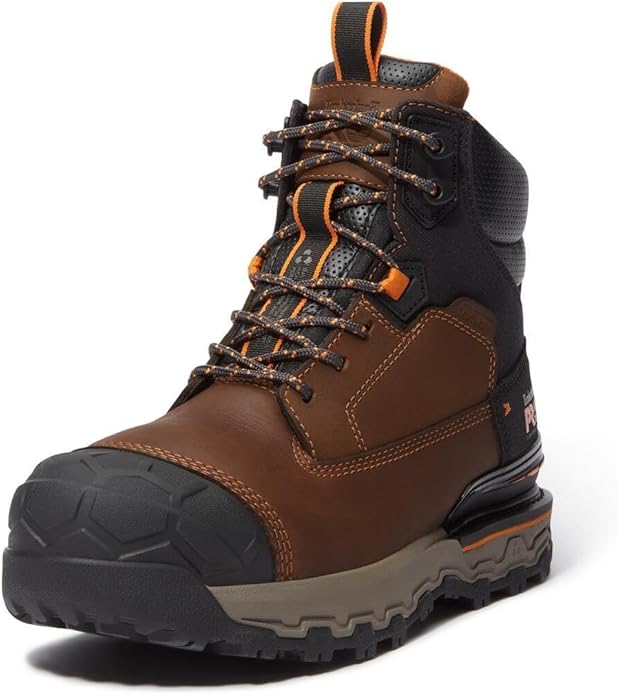
The Timberland PRO Boondock 6″ Waterproof is Timberland PRO’s flagship 6-inch work boot, and it earns that title honestly. It starts with a premium waterproof leather upper backed by an internal waterproof breathable membrane, two layers of wet-weather defense that work together to keep your feet dry without cooking them during long shifts. The Anti-Fatigue Technology footbed uses geometric cone-shaped pods to absorb shock at heel strike and return that energy on push-off. After a 12-hour shift pouring concrete in Rockford or running electrical on a Des Moines commercial project, that energy return is something you actually feel.
The All-Weather TPU outsole is one of the Boondock’s biggest selling points for Midwest workers specifically. Timberland engineered it to maintain flexibility in cold temperatures, a critical detail when standard rubber outsoles go hard and slippery at 15 degrees. The tread bites into wet surfaces, frosted loading docks, and icy parking lots better than most boots in this price range. The composite safety toe meets ASTM F2413-18 standards for impact and compression, and the boot also carries full EH protection against electrical hazards up to 18,000 volts. The molded rubber toe protector adds abrasion resistance where boots take the most abuse, valuable on job sites with steel edges and rebar everywhere.
The compromise with the Boondock is durability at the price point. Some users report sole wear faster than expected, and a few note that the leather stretches after the first month, which can loosen the fit. The break-in period is fairly short, most people are comfortable within a week, but the upper is not as stiff or rugged-feeling as the Carhartt logger equivalents. This is a comfort-first boot that also offers solid protection. If you want a boot that feels good from day one and performs in mixed conditions, the Boondock delivers. If you’re climbing poles or working serious uneven terrain, you may want more ankle support.
Best for: Construction workers and electricians who spend most of their shift on concrete or mixed surfaces and need waterproof protection with all-day comfort.
2. Timberland PRO Pit Boss 6″ Steel Toe: The Workhorse Value Boot
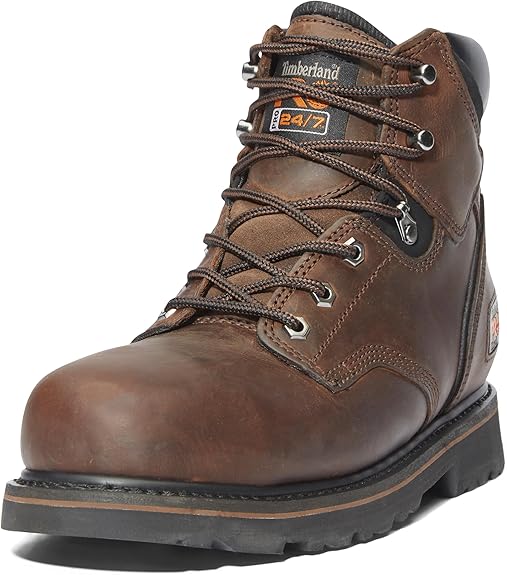
The Timberland PRO Pit Boss 6″ Steel Toe has been on job sites across the Midwest for years, and its staying power says something real. This is a Goodyear welt boot meaning the sole is stitched to the upper with a welt strip, making it more durable over time and resolable when the outsole eventually wears out. The nubuck leather upper is premium and durable. The steel safety toe meets ASTM F2413-18 impact and compression standards, and the boot carries EH protection. The Timberland PRO 24/7 Comfort System provides arch support and cushioning through a full shift, and OrthoLite insoles reduce foot fatigue compared to basic foam alternatives.
The Pit Boss runs a bit stiffer than the Boondock out of the box. Plan on three to five days of break-in before the upper softens and the boot stops rubbing your ankle. Once broken in, most workers find it solidly comfortable for 10-hour shifts. The Timberland PRO Rubber outsole is heat-resistant, slip-resistant, oil-resistant, and abrasion-resistant a full spec sheet that matters when you’re moving across gravel, wet concrete, and machine oil on the same shift. For Midwest winters, it performs reasonably well, though the Pit Boss lacks the cold-temperature flexibility engineering of the Boondock’s TPU outsole. Road salt and slush are manageable, but extended work in sub-zero temps may feel limiting.
The honest trade-off on the Pit Boss is that it does not have built-in waterproofing. The nubuck leather resists moisture but is not sealed with a waterproof membrane. For Illinois warehouse floors and indoor construction, this is a non-issue. For Wisconsin outdoor work in spring mud season or standing water, the Boondock is the smarter choice. The Pit Boss sits at a lower price point typically in the $115 to $145 range making it one of the better values in Timberland PRO’s lineup for workers who spend most of their time indoors or in dry conditions. The aggressive tread pattern does collect mud, which is worth knowing before you bring them into the cab of a pickup.
Best for: Warehouse workers, indoor construction crews, and tradespeople who need reliable safety-toe protection with solid comfort but don’t require waterproofing.
Carhartt Work Boots: Reviewed
3. Carhartt Rugged Flex 6-Inch Composite Toe: The Flexible Every-Day Boot

The Carhartt Rugged Flex 6-Inch Composite Toe Boot does something most work boots don’t bother to do: it flexes with you. The Rugged Flex upper stretches and recovers as you move, which matters more than it sounds when you’re climbing ladders, crouching under equipment, or stepping over construction debris all day. The oil-tanned leather upper handles daily abuse without cracking, and high-abrasion rubber bumpers at the toe and heel add protection in the spots where boots fail fastest. Inside, the FastDry Technology lining wicks sweat away from your foot, a real quality-of-life feature for workers who run hot or can’t rotate pairs during the week.
The Storm Defender waterproof breathable membrane provides solid waterproof protection without trapping heat. Carhartt’s EVA midsole and layered PU footbed system absorbs shock effectively and holds up longer than single-layer foam setups. The composite toe meets ASTM F2413-18 safety standards and carries EH protection. The Rugged Flex outsole provides strong traction on ladder rungs, wet concrete, and uneven terrain. A feature that makes this boot practical for the wide variety of surfaces a Minnesota utility worker or Wisconsin contractor encounters in a single day.
The honest limitation here is the construction method. The Rugged Flex uses cement construction rather than Goodyear welt, meaning when the outsole wears out, the boot is done. You cannot resole it. For a boot in the $110 to $130 price range, that’s a reasonable trade-off, cement construction allows for a more flexible boot, but it’s worth knowing upfront. Some users also report that the arch support, while adequate, is not exceptional, and workers with high arches or existing foot problems may want aftermarket insoles. The boot runs slightly large; most users recommend sizing down half a size.
Best for: Contractors, utility workers, and general tradespeople across the Midwest who need a flexible, waterproof composite toe boot for mixed indoor and outdoor work without spending $200 or more.
4. Carhartt 8″ Waterproof Leather Logger Composite Toe: The Serious Outdoor Boot
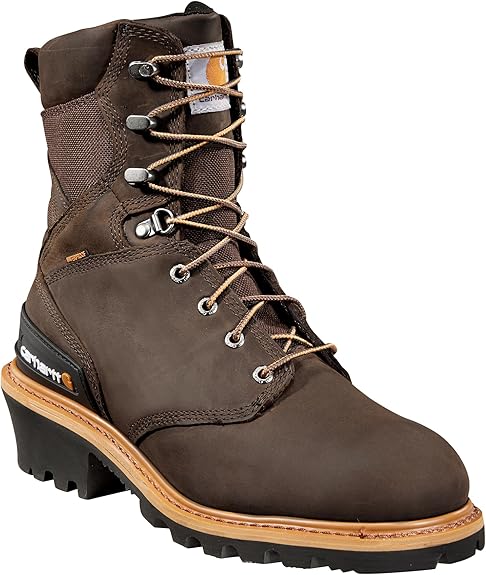
The Carhartt 8″ Waterproof Leather Logger Composite Toe Boot is built for workers who spend serious time on uneven ground, climbing in and out of equipment, or working in genuinely harsh outdoor conditions. The 8-inch oil-tanned vintage saddle leather upper reinforced with 1200 denier ballistic fabric provides ankle support and abrasion resistance that shorter boots simply can’t match. Goodyear welt construction means this boot can be resoled when the outsole wears, making it a genuine long-term investment. The 90-degree heel with Ladder Lock grips is not a marketing detail it’s an actual feature for linemen and utility workers who spend time on pole climbing steps and metal ladders across Iowa and Minnesota.
The Storm Defender waterproof membrane keeps feet dry in standing water, spring slush, and rain that runs down your leg. The 400g 3M Thinsulate insulation manages serious cold we’re talking Minnesota January cold, not October cool. The composite toe satisfies ASTM F2413-18 safety requirements, and the EH rating covers electrical hazard protection up to 18,000 volts. The molded TPU heel stabilizer with Achilles flex joint provides ankle stability on uneven terrain without restricting movement the way rigid heel cups do. A steel shank through the midsole adds torsional stiffness, which matters for comfort on gravel, rough soil, and climbing work.
The trade-off is weight and break-in. This is a heavy boot, and new pairs need seven to ten days of break-in before the leather softens and the boot stops fighting your foot. Some users report tightness in the toe box during break-in, which eases with wear. This is not a boot you put on for the first time before a 12-hour shift. The price runs from $150 to $210 depending on insulation level and retailer, which positions it as a premium option but workers who have owned a pair consistently report multi-year service life, which makes the math work in their favor.
Best for: Linemen, outdoor construction workers, farmers doing field work, and any Midwest worker who needs maximum ankle support, cold-weather insulation, and resolable construction in a single boot.
Timberland PRO vs Carhartt: Head-to-Head

Waterproofing
The Timberland PRO Boondock uses a two-layer system, premium waterproof leather plus an internal breathable membrane that performs exceptionally well in Midwest wet conditions. Reviewers consistently report dry feet through standing water, wet grass, and early spring slush. The Pit Boss does not have a waterproof membrane, which is a significant limitation for outdoor work in the rain.
Carhartt’s Storm Defender system is robust and well-regarded. The Logger boot in particular handles sustained wet exposure in a way that matched or surpassed most competing boots in its class. The Rugged Flex waterproofing holds up well for everyday exposure. Winner: Timberland PRO on the Boondock specifically; Carhartt edges ahead on the Logger for extended wet exposure in outdoor work.
Comfort and Break-In
The Timberland PRO Boondock’s Anti-Fatigue Technology footbed delivers noticeable all-day comfort, particularly for workers on concrete. The Pit Boss takes longer to break in but settles into a comfortable fit after a few days. Timberland PRO consistently wins praise from workers who spend most of their time on flat, hard surfaces.
Carhartt’s Rugged Flex is more comfortable out of the box than most work boots in its class. The Flex construction also reduces the fatigue that comes from fighting stiff leather all day. The Logger requires a real break-in period and is heavier, which adds fatigue over long shifts. Winner: Timberland PRO for day-one and concrete-floor comfort; Carhartt Rugged Flex wins for flexible comfort during active outdoor work.
Durability and Construction
The Timberland PRO Pit Boss uses Goodyear welt construction, a genuine advantage over cement-construction competitors. The Boondock’s construction is solid but some users report sole wear faster than expected at the price point. Both Timberland PRO boots use quality leather, though a subset of reviewers note grommet wear and sole separation over time.
Both Carhartt boots reviewed here are built tough. The Logger’s Goodyear welt construction and vintage saddle leather give it class-leading durability among the four. The Rugged Flex cement construction is a limitation for long-term owners but acceptable at its price point. Winner: Carhartt, particularly the Logger boot, for overall construction durability and long-term service life.
Safety Ratings
Both brands meet ASTM F2413-18 impact and compression standards across all four boots reviewed here. All four carry electrical hazard protection rated for incidental contact with circuits up to 18,000 volts, meeting ASTM F2892-18 EH standards. The Timberland PRO Pit Boss uses a steel toe; the other three use composite toes, which do not conduct heat or cold, a meaningful advantage in Midwest winters where steel toes can get painfully cold. According to OSHA’s PPE guidelines for foot protection, workers should consider environmental temperature when selecting toe protection type. Winner: Draw on safety ratings; composite toe wins for cold weather use.
Price and Value
The Timberland PRO Pit Boss sits around $115 to $145, one of the better values in the lineup. The Boondock runs $150 to $180. The Carhartt Rugged Flex is typically the most affordable of the four, landing between $110 and $130. The Carhartt Logger runs $150 to $210 depending on insulation version.
Goodyear welt construction appears on both the Pit Boss and the Carhartt Logger, meaning both can be resoled. A resole from a local cobbler typically runs $60 to $100, extending boot life significantly. The cement-construction Rugged Flex cannot be resoled. Winner: Carhartt Rugged Flex on initial price; Carhartt Logger and Timberland Pit Boss tie for long-term cost value due to resolability.
Midwest Winter Performance
The Timberland PRO Boondock’s All-Weather TPU outsole maintains flexibility in cold temperatures and provides better traction on frosted and icy surfaces than most outsoles in the category. The Pit Boss is a solid winter boot but does not carry the same cold-flexibility engineering in its outsole.
The Carhartt Logger’s 400g Thinsulate insulation is the warmest option among the four by a significant margin, built for extended outdoor exposure in sub-zero conditions. The composite toes on the Boondock and Logger avoid the heat-conducting problem that steel toes create in deep cold. Winner: Carhartt Logger for cold-weather insulation; Timberland PRO Boondock for icy surface traction.
| Boot Name | Brand | Safety Toe | Waterproof | Construction | Price (Est.) | Best For |
|---|---|---|---|---|---|---|
| Boondock 6″ Waterproof | Timberland PRO | Composite | Yes | Cement | $150–$180 | Job site, mixed conditions |
| Pit Boss 6″ Steel Toe | Timberland PRO | Steel | No | Goodyear Welt | $115–$145 | Indoor, dry conditions |
| Rugged Flex 6″ Composite | Carhartt | Composite | Yes | Cement | $110–$130 | Everyday mixed work |
| 8″ Logger Composite Toe | Carhartt | Composite | Yes | Goodyear Welt | $150–$210 | Outdoor, cold, climbing |
How to Choose Between Timberland PRO and Carhartt
If You Work Mostly Indoors on Concrete
Buy the Timberland PRO Boondock or the Timberland PRO Pit Boss. Timberland PRO’s Anti-Fatigue Technology footbed outperforms Carhartt’s cushioning system when you’re standing still on hard floors for long periods. If you’re on a Wisconsin manufacturing floor, an Iowa distribution warehouse, or an Illinois assembly line, that energy-return footbed makes a real difference by shift’s end. The Pit Boss costs less and works well if waterproofing is not a factor. The Boondock adds waterproofing if your facility has wet zones or wash-down areas.
If You Work Outdoor Construction or Utilities
Go with Carhartt specifically the 8″ Logger Composite Toe for serious outdoor work, or the Rugged Flex if your budget is tighter. The Logger’s 8-inch upper provides ankle support for uneven terrain that a 6-inch boot simply cannot match. The Ladder Lock heel grips and steel shank are built for workers who climb daily, and the Goodyear welt construction stands up to the kind of punishment outdoor construction in Missouri, Minnesota, and Illinois dishes out over a full season. The Rugged Flex is a good budget alternative for lighter outdoor work with mixed indoor time.
If Cold Weather Is Your Biggest Problem
The Carhartt 8″ Logger with 400g Thinsulate insulation is the clear pick for Midwest winter work. Workers in Minnesota, Wisconsin, and the Dakotas who spend long hours outside in January and February need dedicated insulation, not just a waterproof membrane. The Logger keeps feet warm in sustained sub-zero conditions in a way that the Boondock, which offers no insulation in its standard version cannot. The composite toe also stays temperature-neutral, which matters when steel toes can make your feet feel like they’re in a freezer after an hour in the cold. If you want a Timberland PRO cold-weather option, look for the Boondock Insulated version, which adds 200g insulation to the standard boot.
If Budget Is the Priority
The Carhartt Rugged Flex 6-Inch Composite Toe is your boot. It runs $110 to $130, delivers real waterproofing, a composite safety toe, EH rating, and flexible comfort that is genuinely better than most boots at the same price. It is cement constructed, so you will eventually need to replace it rather than resole it but at the price, you are getting a boot that outperforms what you’re paying for. The Timberland PRO Pit Boss is a close runner-up at $115 to $145, but the Rugged Flex beats it on value for outdoor workers because it includes waterproofing the Pit Boss lacks.
If You Need Electrical Hazard Protection
All four boots reviewed here carry EH ratings, so you’re covered regardless of which you choose. That said, workers who spend significant time near live electrical components, linemen, electricians, industrial maintenance crews should also consider ASTM F2413-18 Class EH requirements in their site-specific risk assessment. For linemen who also climb, the Carhartt Logger’s Ladder Lock heel and EH protection make it the most purpose-built boot in this comparison. For electricians doing indoor work who need EH coverage without maximum ankle height, the Timberland PRO Boondock is the more comfortable daily driver.
Making Your Work Boots Last
Daily Maintenance
At the end of every shift, knock mud and debris off the outsole before it hardens. In Midwest winters, road salt is the biggest daily threat, salt crystals draw moisture out of leather and break down stitching faster than almost anything else. Wipe down the leather upper with a damp cloth to remove salt residue before it dries. Remove your insoles and let them air separately. A boot that dries from the inside out lasts significantly longer than one that stays damp overnight. A boot dryer the kind that blows low-heat air through the boot, is a $30 investment that extends boot life by months.
Weekly Care
Once a week, condition the leather with a product designed for oiled or nubuck leather. For Carhartt’s oil-tanned leather, mink oil or a dedicated oil-tanned conditioner works well and keeps the leather supple without over-softening it. For Timberland PRO’s nubuck uppers, use a nubuck-specific conditioner rather than oil, which can darken and alter the texture. Check your laces for fraying and replace them before they snap mid-shift. Inspect the welt or glue line around the sole catching a small separation early means a $5 tube of boot cement repair rather than a $60 cobbler bill.
Salt Season Protocol
Midwest winters are hard on boots in a way that outdoor work in other seasons is not. Road salt and brine compounds spread from November through March, and they will destroy unprotected leather faster than any other single factor. At the start of salt season, treat your boots with a waterproof sealant or wax. Obenauf’s Heavy Duty LP is a highly regarded option that penetrates leather, conditioning it while building a protective barrier against salt and chemical exposure. Reapply every four to six weeks through the winter, and after any day where you’ve been in heavy slush or brine. When you get home from a tough day, rinse the exterior with clean water before salt can dry into the leather grain.
When to Repair vs. Replace
Goodyear welt boots, the Timberland PRO Pit Boss and the Carhartt Logger can be resoled when the outsole wears flat or the tread loses traction. The upper leather, welt stitching, and internal components can all outlast multiple soles. A local cobbler can resole most welt construction boots for $60 to $90, which makes a $150 boot a $240 boot over two sole replacements still cheaper than two new pairs. Cement construction boots like the Carhartt Rugged Flex and standard Timberland PRO Boondock should be replaced when the outsole tread depth drops below a quarter inch or when the midsole feels flat and unresponsive. Don’t wait for the upper to fall apart, sole wear and midsole compression affect your joints long before you notice the boot looks worn out.
Midwest-Specific Considerations

Winter Cold and Steel vs. Composite Toes
Steel toes conduct temperature. In a Minnesota January where actual air temperature drops to minus-20 and windchill pushes below minus-40 a steel toe becomes a cold metal shell around your toes. Workers on the Iron Range, utility crews in northern Wisconsin, and outdoor construction workers across the Dakotas consistently report that composite toes are the right choice for cold-weather work. Composite toes meet the same ASTM safety certification standards as steel but do not conduct cold. Three of the four boots reviewed here use composite toes for exactly this reason. If you work primarily indoors or in a climate-controlled environment, steel toe is a non-issue. If you work outside in real Midwest cold, composite is the smart call.
Salt and Chemical Exposure
Midwest roads are treated aggressively from October through April. Salt, magnesium chloride, and calcium chloride brine all accelerate leather degradation. Workers who cross treated parking lots and roadways daily which is essentially every Midwest tradesperson need boots with oil-tanned or treated leather and proper sealing maintenance. Carhartt’s oil-tanned leather holds up to chemical exposure particularly well, which is one reason the brand is so deeply embedded in industrial maintenance and waste treatment work. Timberland PRO’s premium nubuck is durable but requires more diligent conditioning to resist salt penetration.
Spring Slush and Mud Season
April through May in Iowa, Illinois, and Wisconsin means clay-heavy mud, slush, and standing water in construction site low spots. This is where waterproof membranes earn their keep. Boots without waterproofing like the Timberland PRO Pit Boss will let water in when you’re walking through standing slush or stepping off a construction site into a wet parking lot. The Boondock and both Carhartt options handle spring conditions well, but the Logger’s 8-inch height adds crucial protection when you’re stepping through muddy job site access paths. Ladder Lock tread on the Carhartt Logger sheds clay mud better than the Boondock’s standard lug pattern.
Concrete Floors in Manufacturing and Warehouses
The Midwest’s manufacturing core automotive suppliers in Ohio and Indiana, food processing across Iowa and Minnesota, distribution centers spreading across every major metro puts millions of workers on concrete for 8 to 12 hours a day. Concrete has no give. It transfers impact force directly into your feet, knees, and lower back. This is where Timberland PRO’s Anti-Fatigue Technology makes its biggest argument. Workers who switched to the Boondock from basic safety boots consistently report less knee and back fatigue at shift’s end. According to research from the Stridewise work boot testing database, boots with dedicated midsole cushioning and energy-return technology show measurable improvement in comfort metrics for workers on hard floors versus boots with basic foam insoles. If concrete is your floor, prioritize the footbed and midsole technology and Timberland PRO leads that category.
Timberland PRO vs Carhartt: The Verdict
Best Overall Boot: The Timberland PRO Boondock 6″ Waterproof earns this spot. It combines genuine waterproof protection, all-day comfort technology, EH rating, composite safety toe, and cold-weather outsole performance in a boot that works across more Midwest job site conditions than any other boot in this comparison. It handles Iowa construction sites, Illinois warehouse floors, and Wisconsin wet-weather utility work without making you choose between comfort and protection.
Best for Budget: The Carhartt Rugged Flex 6-Inch Composite Toe Boot at $110 to $130 delivers waterproofing, composite safety toe, EH protection, and flexible comfort that outperforms its price point. If you need a solid everyday work boot without spending $175, this is the one.
Best for Outdoor Construction: The Carhartt 8″ Waterproof Leather Logger Composite Toe Boot wins this category without a close second. The 8-inch upper, Goodyear welt, insulation, Ladder Lock heel, and ankle support package is built exactly for the outdoor construction and utilities worker who works hard terrain in real Midwest weather. It’s the boot Minnesota and Wisconsin outdoor workers reach for when conditions get serious.
Best for Indoor/Concrete Work: The Timberland PRO Boondock 6″ wins here too, with its Anti-Fatigue Technology footbed making a measurable difference for workers on concrete all day. If the budget is tighter, the Timberland PRO Pit Boss delivers solid indoor comfort with Goodyear welt durability at a lower price.
Best Overall Brand for the Midwest: This is a genuinely close call closer than most comparison articles will admit. Timberland PRO wins for workers based primarily indoors or in mixed environments who prioritize comfort technology and all-weather outsole performance. Carhartt wins for outdoor workers, cold-weather conditions, and anyone doing serious hard terrain work. Given the Midwest’s mix of hard winters, spring mud, and heavy manufacturing employment, Carhartt edges ahead as the better all-around choice for the region’s most demanding work conditions. Their boots are built for exactly the kind of punishment that Midwest job sites deliver, and the Goodyear welt construction on their best models means a good pair of Carhartt loggers stays in service far longer than most competitors.
Looking for More
If you work farm ground or split your time between job site and fields, our roundup of the 7 Best Farm Work Boots for Mud, Fields & Chores covers options built specifically for that overlap. It’s worth a read before you commit to a strictly job site boot if your work puts you on both surfaces.
FAQs
It depends on the model, and that distinction matters. The Carhartt 8″ Logger uses Goodyear welt construction with vintage saddle leather a combination that produces one of the more durable boots on the market at any price point. Workers in industrial maintenance and outdoor trades consistently report three or more years of hard service from that boot with proper care and one or two resoles. The Timberland PRO Pit Boss also uses Goodyear welt, which gives it comparable durability potential. Where Carhartt has a clear edge is in the quality of the leather itself the crazy horse oil-tanned leather resists chemical exposure, abrasion, and moisture better than nubuck over the long term. Timberland PRO’s cement-construction Boondock does not have the same longevity as either welt boot. The honest answer: if you want the most durable boot in this comparison, buy the Carhartt Logger. If you want strong durability at a lower price, the Timberland PRO Pit Boss is a close runner-up.
For the right worker, yes without hesitation. The Boondock sits in the $150 to $180 range, which is not cheap, but it delivers a combination of waterproofing, Anti-Fatigue Technology, cold-weather outsole engineering, and EH protection that you don’t find at $100. Workers who log 10 to 12 hours a day on concrete or mixed job site surfaces and who work in Midwest weather year-round will feel the difference in that footbed by the end of the first week. The trade-off is that the Boondock uses cement construction, meaning it cannot be resoled. When the outsole wears out, the boot is done. That limits its long-term value compared to the Goodyear welt Pit Boss or the Carhartt Logger. But for pure day-to-day performance on job sites from May through November in the Midwest, the Boondock earns its price.
Both systems work well in real conditions, and neither is dramatically better than the other in casual use. The difference shows up in sustained exposure. Carhartt’s Storm Defender uses a breathable waterproof membrane that allows moisture vapor to escape while blocking liquid water standard waterproof breathable technology. Timberland PRO on the Boondock uses the same concept but adds premium waterproof leather as a first layer of defense before moisture even reaches the membrane. That dual-layer approach gives the Boondock an edge in situations like standing water and heavy rain. For the Carhartt Logger, the oil-tanned leather adds the same type of first-layer defense. Both brands’ waterproofing systems hold up well for the first two to three years with proper conditioning maintenance. The waterproofing degrades faster in boots that dry out and crack from salt exposure without regular treatment. Both brands will leak eventually if the leather is not maintained.
Yes, but only the specific models built with Goodyear welt construction. Of the four boots reviewed here, the Timberland PRO Pit Boss 6″ and the Carhartt 8″ Logger both use Goodyear welt construction, which makes them resolable by a skilled cobbler. A local shoe repair shop can replace the outsole for $60 to $90, and many will also replace the insole and refinish the leather at the same time. A good welt-construction boot can realistically go through two or three resoles over its life, making it significantly more economical than buying a new boot every 18 months. The Timberland PRO Boondock and the Carhartt Rugged Flex both use cement construction the outsole is glued to the upper rather than stitched through a welt which means they cannot be professionally resoled. When the outsole on those boots is gone, the boots are done. If resolability matters to your budget, build your purchase decision around the Pit Boss or the Carhartt Logger.
Carhartt work boots generally fit wide feet better than Timberland PRO boots, though both brands offer wide sizes. The Rugged Flex line runs slightly large, and many users find it roomy in the toe box even in standard width which is good news for workers with broader feet. The Carhartt Logger has a traditional logger fit that is not especially narrow. The Timberland PRO Pit Boss runs narrower in some sizes, and multiple reviewers with wider feet report the steel toe feeling tight, particularly during break-in. The Boondock has a more comfortable toe box in the composite toe version than many steel toe alternatives. If you have genuinely wide feet, look for both brands’ EE wide-width options, which are available for most of the boots reviewed here. Trying them on in person or ordering from a retailer with easy returns is the safest approach before committing to a full-price pair.
