


Let me be straight with you right out of the gate. Most work boots under $70 are garbage. Not “pretty good for the price” garbage genuine, fail-in-three-months, blister-your-heels, soles-peeling-by-Thanksgiving garbage. I’ve worn enough of them to know. When you’re working a full shift in January in Minnesota or standing on a wet Wisconsin concrete floor for ten hours, bad boots aren’t just uncomfortable. They’re a problem that follows you home.
So when the Safety Loong Men’s Work Boots started showing up everywhere online ranked high in Amazon’s industrial and construction boot category, pulling in surprisingly positive reviews, and sitting at just $59.98 I paid attention. Not because I thought they’d blow my Timberland PRO off its shelf. But because the guys actually buying these boots seemed genuinely satisfied. That doesn’t happen often with budget footwear, and it was worth a closer look.
What I found is more nuanced than a simple yes or no. These boots do a few things better than they have any right to at this price. They also have real limitations that some reviews gloss over and one limitation that could matter a lot depending on where you work. I’m going to give you the full picture so you can decide whether $60 is money well spent or money wasted on your specific situation.
This review covers everything: the real specs, the waterproofing question, how the leather holds up, what “welt construction” actually means here, the soft toe trade-off, how they perform in Midwest conditions, and who should buy them versus who should skip them and spend more. By the end, you’ll have a clear answer.
What Makes Budget Work Boots So Hard to Get Right
Before we get into the Safety Loong specifically, it’s worth understanding why most boots in this price bracket fail because the Safety Loong sidesteps some of these traps while falling straight into others.
The $60 Boot Problem
Quality work boot construction costs money. Full-grain leather, Goodyear welt stitching, quality rubber compounds, and ASTM-certified safety toes all add manufacturing cost. Brands that sell legitimate work boots in the $60 range almost always cut corners somewhere. The question is where.
OSHA’s footwear standards require employers to ensure workers in hazardous environments use protective footwear that meets ASTM F2413 standards. That standard defines the specific impact and compression resistance safety toes must provide. A boot that doesn’t carry ASTM F2413 certification cannot be used to satisfy those requirements, no matter what the marketing says. This is the first thing you need to know about the Safety Loong soft toe version: it does not carry ASTM F2413 safety toe certification. It has no safety toe at all. In OSHA-regulated environments where safety toes are required, these boots do not qualify. I’ll say that again because it matters: if your employer requires certified safety footwear, these boots are not it.
That’s not a knock on the boot. It’s a fact you need before you click buy.
Where Cheap Leather Shows Its Age
The second common failure point in budget boots is leather quality. True full-grain leather the highest quality, cut from the outermost hide layer costs more than split-grain or genuine leather. Some brands market “top-grain” or “full-grain” leather without delivering the thickness and density that those terms imply at a quality level. Budget leather cracks faster, absorbs water more readily, and breaks down under road salt in a single Midwest winter.
According to the Leather Working Group, environmental and quality standards for leather production vary enormously by tannery. Brands sourcing leather from unverified suppliers often get inconsistent quality good batch, bad batch, with no way to know which you’re getting.
Safety Loong Men’s Work Boots Waterproof Soft Toe, The Full Review
Current Price: $59.98 ➡️ Check Price on Amazon
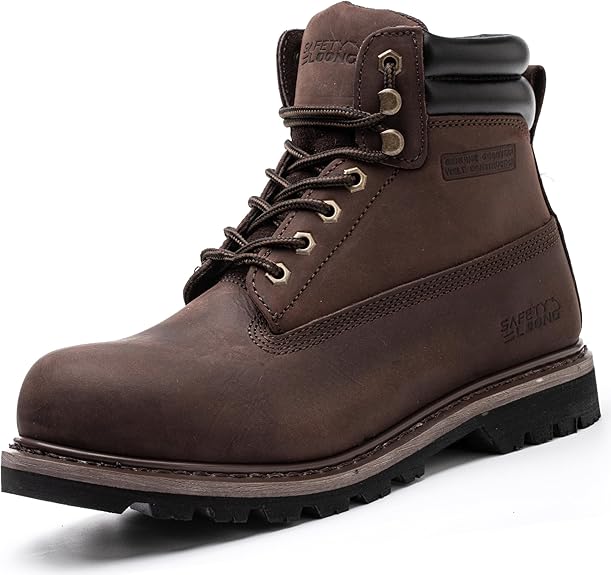
The Safety Loong soft toe work boot is a 6-inch leather boot built around a pretty straightforward premise: give a guy who doesn’t need a certified safety toe a durable, reasonably waterproof, comfortable boot at a price that doesn’t hurt. It’s not trying to be a Thorogood or a Timberland PRO. It’s trying to be the best boot you can get for $60. Whether it succeeds depends entirely on what you’re asking it to do.
What Works
The leather is the first thing you notice when these boots arrive. For a $60 boot, the top-grain leather feels more substantial than you’d expect. Multiple buyers describe opening the box and immediately smelling real leather that’s not nothing at this price point. The leather holds up reasonably well against scuffs, dust, and light moisture, and it breaks in to a comfortable, supple fit rather than staying rigid and stiff. It won’t mold to your foot the way oil-tanned American leather on a Thorogood does, but it moves in the right direction over the first few weeks of wear.
The soft toe design is a genuine comfort advantage for workers who don’t need impact protection. Without a steel or composite cap compressing the toe box, your toes have room to spread and flex naturally. After a full shift of climbing, kneeling, and pivoting, that flexibility matters. The toe box feels roomy and comfortable, and several buyers with wider feet specifically noted that the fit worked where narrower safety toe boots had failed them.
The cushioned insole, padded collar, and extra ankle padding all contribute to a boot that many buyers describe as comfortable right out of the box. That’s rare. Most quality work boots need a week of gradual break-in before they stop torturing you. The Safety Loong softens quickly and doesn’t punish you for putting in full shifts early. The removable insole is a smart feature — it lets you drop in aftermarket orthotics or a more supportive footbed if the stock cushion doesn’t cut it for your arch type.
The non-slip rubber outsole grips concrete, damp gravel, and light rain conditions well. On dry concrete and plywood, traction is solid and the boot feels planted. The “welt construction” referenced in the listing creates a boot that feels structured underfoot the sole doesn’t flex oddly or create pressure points during extended standing. Double stitching reinforces the upper in the areas that take the most stress, and it shows in the overall feel of durability.
Midwest-Specific Performance
For Midwest workers, there are a few things worth knowing specifically.
The leather’s water resistance handles wet Wisconsin mornings and light MN slush reasonably well provided you treat the leather regularly. This is not a sealed-membrane waterproof boot. One reviewer who sliced a pair open to inspect the construction reported that true waterproofing is limited, and that water can eventually penetrate around the welt area during extended exposure. The marketing calls these “waterproof,” but the honest description is “water-resistant.” For walking across wet parking lots, morning dew on grass, and light rain, you’ll stay dry. For standing in active puddles, wading through deep slush, or working in wet conditions for hours at a stretch, these boots will eventually let water in. That’s not a dealbreaker for every Midwest worker. But it is something you need to know before you’re four hours into a wet February day wondering why your socks are wet.
Cold weather performance is decent for an uninsulated boot. The leather construction runs warmer than a mesh work shoe. In mild Minnesota winters or heated shop environments, they’re comfortable with regular work socks. In hard subzero temperatures outdoors, you’ll want thick wool socks to compensate for the lack of insulation. There’s no lining that would trap significant warmth.
The traction, while good on most surfaces, draws one consistent complaint from buyers working on smoother or oilier surfaces. Slip resistance on wet tile, polished concrete, and slick metal is adequate but not exceptional. “Non-slip” is not “slip-proof,” and buyers who work in food service, manufacturing with machine oil, or other slippery environments should note this. One reviewer specifically mentioned the sole is less slip-resistant than expected for those conditions.
Road salt is the wildcard. Like any leather boot at this price point, regular conditioning and salt removal after exposure matters more here than with premium-leather boots. Neglect that, and you’ll shorten the lifespan noticeably.
The Honest Limitations
The “welt construction” language in the listing deserves a direct call-out. This is not a true Goodyear welt boot. One buyer who actually cut the sole open to examine the construction found that the outsole attachment is primarily cement-bonded (glued), not stitched through to the insole. The welt is decorative. That means these boots cannot be resoled. When the outsole wears out, you’re buying a new pair not paying a cobbler $80 to extend the life of your boots another year or two. At $60, that’s a fair trade-off for many buyers. But if you’re comparing the “welt construction” claim to a Thorogood or Danner where that construction is the real thing, don’t get misled.
Durability expectations need to be set correctly. Under normal daily work conditions, buyers report roughly 10–14 months of good service. Heavy-duty work shortens that. Lighter use extends it. One buyer put it well: these are fine for a year, then get new ones. For someone replacing boots every year anyway which many Midwest guys do $60 beats $200 by a lot in that math. For someone who wants boots that last three-plus years with resoling, these aren’t that boot.
The speed hooks on the lacing system show up in multiple reviews as a quality control weak point. Loose speed hooks out of the box are a recurring complaint. One buyer fixed the issue with needle-nose pliers; others found them annoying enough to mention. It’s not a boot-ending problem, but it’s a fit-and-finish issue you don’t see on better-built boots.
The interior liner has a gap in the toe area that a few buyers noticed the lining doesn’t fully cover the toe box interior. Minor detail, but the kind of thing that separates a $60 boot from a $160 one. None of these issues are catastrophic. Together, they paint a clear picture: you’re getting solid value, not premium quality.
Best For
These boots make the most sense for workers in environments where ASTM safety toes are not required general property maintenance, landscaping, light construction work, farm chores, delivery driving, and anyone using boots for outdoor weekend work rather than full-time industrial shifts. They’re also a strong choice as a secondary pair: solid enough for non-critical days, easy on the wallet when work is rough enough on boots that you’d rather sacrifice a $60 pair than a $180 one. First-time work boot buyers who want to understand what features they actually need before committing to a premium pair will also do well here.
They’re not the right boot for anyone under OSHA requirements for safety toe footwear, anyone working in environments with crush hazards, workers needing genuine all-day waterproofing in wet Midwest conditions, or anyone who wants a boot to last three-plus years and be resoleable.
Price: $59.98 ➡️ Check Price on Amazon
How to Get the Most Out of These Boots
Budget boots reward you when you take care of them. Neglect them and they’ll confirm every bad thing you’ve ever thought about cheap footwear. These steps will push the lifespan of the Safety Loong toward the high end of what they’re capable of.
Weekly Leather Care
Treat the leather with a quality conditioner every couple of weeks. Leather conditioner keeps the upper flexible, prevents cracking, and restores natural water resistance. Beeswax-based products like Otter Wax or Obenauf’s Heavy Duty LP work particularly well on budget leather they’re thicker and more protective than lighter conditioners. At $15–20 a tin, these products extend the life of a $60 boot by months.
If you’re working through a Midwest winter, salt removal is non-negotiable. After any day with road salt or de-icer exposure, wipe the boots down with a damp cloth before the salt can work into the leather. A dedicated salt-removal product does more than plain water it neutralizes the salt residue rather than just spreading it around. Apply a fresh coat of conditioner after any heavy salt exposure.
Drying Them Right
Never put these boots on a radiator, near a heating vent, or under any direct heat source to dry them. Direct heat cracks leather and degrades the cement bond on the outsole faster than anything else. Let them air dry naturally. If they’re soaked, stuff them with newspaper to absorb moisture and maintain shape, then give them 24 hours before the next wear. If your work regularly gets them wet, owning two pairs and rotating is smarter than running one pair into the ground.
Replace the Insole Early
The stock insole is comfortable but not exceptional. If you’re on your feet for long shifts, drop in an aftermarket footbed after the first month or two before the stock insole compresses and flattens out. Superfeet Green or Dr. Scholl’s Work insoles run $30–50 and genuinely improve the all-day comfort of these boots. Since the insole is removable, swapping is easy. Workers with flat feet or any kind of arch issue should do this from day one.
How They Stack Up Against More Expensive Options
This is a fair question and worth addressing directly. The Safety Loong at $60 is not the same boot as a Wolverine Floorhand at $100 or a Timberland PRO at $160. But the comparison isn’t as simple as “you get what you pay for.”
The Wolverine Floorhand gives you a waterproof membrane that actually seals moisture out, a steel toe that meets ASTM F2413 standards, and a cement construction that, while not resoleable, uses a more robust outsole compound. For workers who need OSHA-compliant safety toe protection, the Floorhand at $100 is worth the extra $40. For workers who don’t need that protection and won’t be standing in puddles all day, the Safety Loong’s value is real.
The Timberland PRO Boondock at $160 is a different animal entirely true waterproofing, Anti-Fatigue Technology, composite safety toe, and a construction quality that, with care, lasts two-plus years. It’s a better boot. It also costs more than twice as much. Over 12 months of daily use, the Timberland PRO still wins on cost-per-wear, but it’s a larger upfront investment. If you’re on a tight budget and your work environment doesn’t mandate a safety toe, the Safety Loong gets you on the job with solid comfort and reasonable durability at a price that doesn’t hurt.
The honest comparison math: if you expect these boots to last a year of regular use, that’s roughly $0.16 per day. For that number, the Safety Loong delivers genuine value. If you need boots to last longer than that or to meet specific safety certifications, spend more. If you don’t, these earn their spot.
Who Should Buy the Safety Loong Soft Toe And Who Should Skip It
Buy these if: Your job does not require ASTM-certified safety toe footwear. You need a comfortable, reasonably waterproof leather boot at a price that won’t hurt when work beats them up. You’re in a non-industrial role property maintenance, light construction, farm work, landscaping, delivery, general outdoor work. You want a secondary pair for days where conditions are rough enough that you’d rather sacrifice a $60 boot. You’re between premium boot purchases and need something functional while you save up.
Skip these and spend more if: You work in an OSHA-regulated environment that requires certified safety toe protection these boots will not satisfy that requirement. You work in genuinely wet conditions for extended periods the water resistance here is real but limited. You need boots that last more than 12–14 months of daily hard use. You work on consistently slippery or oily surfaces where maximum traction is critical. You want a resoleable boot that you can maintain for years rather than replace annually.
Looking for More
If you’re still weighing your options, the 10 Best Work Boots for the Midwest covers the full range of work boot options across all price points and use cases from the best budget picks to the premium boots worth serious investment. If you specifically need men’s work boots with safety certifications, 10 Best Work Boots for Men in the Midwest breaks down the top picks with ASTM safety toe ratings, waterproof membranes, and construction quality built to last.
FAQs
No. The soft toe version carries no ASTM F2413 certification for impact or compression resistance. OSHA’s regulations under 1910.136 require protective footwear that meets recognized safety standards in environments with foot hazards. The Safety Loong soft toe does not meet those standards and cannot be used to satisfy OSHA safety footwear requirements. If your employer requires certified safety footwear, you need a boot with an ASTM-certified steel, composite, or alloy toe. Safety Loong does make a separate steel toe model that’s a different product entirely. Be completely clear about which version you’re looking at before you buy, because the difference matters significantly in regulated work environments.
he marketing uses “waterproof,” but the honest performance is closer to water-resistant. The leather and construction repel light moisture effectively wet morning grass, light rain, a quick puddle crossing. For extended exposure to wet conditions, standing in slush, or prolonged rain, water eventually penetrates around the welt area. One buyer who examined the construction closely found the waterproofing isn’t sealed as fully as a boot with a dedicated waterproof membrane like Gore-Tex. Regular leather conditioning and a wax-based waterproofing treatment improves water resistance significantly. For typical Midwest wet-weather commutes and light work conditions, these boots keep feet dry. For extended wet-work scenarios, they’re not the right tool.
With regular wear in typical work conditions and proper care, expect 10–14 months of solid performance. Heavy-duty industrial work or outdoor construction shortens that estimate. Light maintenance work or part-time use extends it. Because the outsole is cement-bonded rather than stitched, these boots cannot be resoled when the sole wears out at end of life, you buy a new pair. For someone who replaces boots annually anyway, $60 is an easy value proposition. For someone expecting two-plus years of daily wear, these aren’t the right investment. Proper leather conditioning, prompt drying after wet days, and regular salt removal after winter work will push these toward the higher end of their lifespan.
They work in moderate winter conditions with the right sock choice. These boots carry no insulation, so in subzero Minnesota temperatures you’ll need heavy wool socks to stay comfortable outdoors. The leather construction runs warmer than a mesh boot, which helps. The water resistance handles typical slush and wet conditions adequately for light exposure, though the limitations described above apply extended wet exposure eventually wins. For primarily indoor work with cold outdoor commutes, these handle winter fine. For outdoor work in genuine Minnesota cold or extended wet-slush conditions, you want either a genuinely insulated waterproof boot or a premium construction with sealed waterproofing. The Safety Loong is solid spring-through-fall footwear with reasonable winter performance for mixed-use workers.
